
Commercial real estate ERP software built for multi-asset portfolios
A specialist commercial real estate ERP software engagement. Lease management, general ledger, AP, AR, budgeting, forecasting, CAM reconciliation, TI tracking, and portfolio-wide financial reporting in one system. Built for office, retail, industrial, warehousing, and mixed-use operators who have outgrown Yardi Voyager, MRI, and RealPage or need custom logic those platforms cannot deliver.
Trusted by 50+ operators, PropTech companies & digital-first brands


























Built for these operators

Office portfolio operators
Class A and B office landlords running 5 to 50+ buildings across multiple markets who need lease abstraction, CAM reconciliation, and consolidated portfolio reporting inside one system.
Retail leasing operators
Mall owners, high-street retail landlords, and mixed-format centres. Percentage rent calculations, sales reporting, co-tenancy tracking, and marketing fund reconciliation.
Industrial and warehousing operators
Logistics parks, distribution centres, and last-mile hubs. Long-term triple-net leases with escalations, expansion options, and complex TI packages that need tracked.
Mixed-use developers and operators
Office + retail + residential + hospitality under one master brand. Cross-vertical lease logic, revenue attribution, and portfolio consolidation.
REITs and institutional asset managers
Portfolio-level reporting, fund-level financials, investor-grade audit trails, and SOX-aware controls across office, retail, industrial, and mixed-use assets.
Real estate private equity funds
Deal-level economics, waterfall calculations, capital calls, and investor distributions integrated with asset-level lease and financial data.
Property management firms managing commercial assets
Third-party PMs running mixed portfolios on behalf of owners who need multi-owner ledger segregation, owner reporting, and fee calculation.
Everything you need, in one engagement
Lease management and abstraction
Every lease abstracted into structured data. Escalations, options, exclusives, use restrictions, TI packages, LL and TT obligations, co-tenancy triggers all tracked.
General ledger and financial core
Multi-entity, multi-currency GL with automated recurring journals, accrual accounting, cash-basis reporting, and audit-ready trail.
Accounts payable and receivable
AP workflow with vendor management, 3-way match, and approval routing. AR with tenant billing, late-fee automation, and receivables aging.
CAM reconciliation engine
Annual CAM reconciliation with expense allocation methods (gross-up, base-year, per-SF), tenant-share calculation, and reconciliation packages generated automatically.
Budgeting and forecasting
Rolling budgets, variance analysis, and revenue forecasting driven by lease abstract data. Scenario modelling for renewal probabilities, market rent trends, and TI investment.
TI (tenant improvement) tracking
TI budgets, actuals, contractor payments, allowances vs over-standard, and TI amortisation into lease economics.
Portfolio-wide reporting
Occupancy, WALT (weighted average lease term), tenant concentration, expiration schedules, rent roll, and NOI reported across the entire portfolio or filtered per asset, per fund, per market.
Integration layer
APIs to Yardi Voyager, MRI, RealPage, QuickBooks, Xero, Concur, Docusign, Salesforce, HubSpot, and your existing accounting stack. Migration paths built in.
Investor reporting and portal
Distribution schedules, capital calls, K-1 and K-2 delivery, quarterly reports, and secure investor portal access.
A predictable, weekly cadence
- 01
Discovery (Week 1-2)
Portfolio audit, existing stack review, lease data assessment, workflow mapping, integration inventory.
- 02
Data architecture (Week 3-4)
Chart of accounts, entity structure, lease data model, integration schema, security and audit design.
- 03
Build (Week 5-16)
Core ledger, lease module, AP / AR, CAM engine, reporting, integrations built in parallel sprints.
- 04
Data migration (Week 17-19)
Historic lease abstraction, GL migration, AR / AP balance transfers, parallel-run validation.
- 05
UAT and training (Week 20-22)
User acceptance testing, key-user training, month-end close simulation, sign-off gates.
- 06
Go-live (Week 23-24)
Cutover, first close on new system, daily hypercare for 30 days, iterative refinements.
- 07
Operate (ongoing)
Quarterly system reviews, annual CAM reconciliation support, new feature roadmap, integration maintenance.
Opinionated for real estate
Stack
- Next.js
- TypeScript
- PostgreSQL
- Prisma
- Node.js
- Redis
- Elasticsearch
- AWS
- SOC 2
- Yardi Voyager API
- MRI API
- RealPage API
- QuickBooks
- Xero
- Concur
- Docusign
- Snowflake
- Metabase
What clients walk away with
12 → 4
days to close the month on the new ERP
0%
manual escalation billing errors post-migration
8 → 2
weeks for annual CAM reconciliation cycle
18%
average accounting cost reduction vs legacy stack
Pick the tier that fits
Modular Build
Custom scoped
12-16 weeks
- Single-module ERP (lease OR ledger OR CAM)
- For operators with existing systems needing one component custom-built
- Integration with existing Yardi / MRI / RealPage
- Most popular
Full ERP Platform
Custom scoped
20-28 weeks
- Complete ERP replacement
- For multi-asset commercial operators outgrowing off-the-shelf tools
- Data migration + parallel run + 30-day hypercare
Enterprise ERP
Custom scoped
30+ weeks
- Multi-entity, multi-currency, multi-country ERP
- For REITs, institutional funds, and cross-vertical operators
- Investor reporting + SOX-aware controls + audit trail
Side-by-side, with the alternatives
| Capability | Noseberry | Yardi Voyager | MRI Software | Excel + QuickBooks |
|---|---|---|---|---|
| Commercial-specific logic | Custom to your model | Configurable | Configurable | |
| Custom lease clauses | Any structure | Within standard | Within standard | Manual |
| Owned code | ||||
| Vendor lock-in | ||||
| Per-user pricing | None (owned) | Per seat | Per seat | Low |
| Reporting customisation | Unlimited | Templated | Templated | Manual |
| Migration risk | Managed 24/7 | Vendor-led | Vendor-led | — |
Commercial-specific logic
- Noseberry
- Custom to your model
- Yardi Voyager
- Configurable
- MRI Software
- Configurable
- Excel + QuickBooks
Custom lease clauses
- Noseberry
- Any structure
- Yardi Voyager
- Within standard
- MRI Software
- Within standard
- Excel + QuickBooks
- Manual
Owned code
- Noseberry
- Yardi Voyager
- MRI Software
- Excel + QuickBooks
Vendor lock-in
- Noseberry
- Yardi Voyager
- MRI Software
- Excel + QuickBooks
Per-user pricing
- Noseberry
- None (owned)
- Yardi Voyager
- Per seat
- MRI Software
- Per seat
- Excel + QuickBooks
- Low
Reporting customisation
- Noseberry
- Unlimited
- Yardi Voyager
- Templated
- MRI Software
- Templated
- Excel + QuickBooks
- Manual
Migration risk
- Noseberry
- Managed 24/7
- Yardi Voyager
- Vendor-led
- MRI Software
- Vendor-led
- Excel + QuickBooks
- —
Frequently asked questions
What is commercial real estate ERP software?
Commercial real estate ERP software is an enterprise resource planning system built specifically for commercial real estate operators. It combines lease management, general ledger, AP, AR, CAM reconciliation, TI tracking, budgeting, and portfolio reporting into one integrated system. Unlike generic ERP (SAP, Oracle) or off-the-shelf property platforms (Yardi, MRI, RealPage), custom commercial real estate ERP software is scoped to your specific asset mix, business model, and integration landscape.
When should we consider custom commercial real estate ERP software over Yardi or MRI?
When your business model doesn't fit the templated workflows of Yardi Voyager or MRI. Common triggers: complex lease structures the platforms cannot represent, multi-currency or multi-entity requirements they handle poorly, custom reporting the platforms cannot deliver, or licensing costs at scale that exceed the cost of ownership of a custom platform. Most operators are best served by Yardi or MRI. Custom ERP is for the 10 to 15% who genuinely need it.
How long does a commercial real estate ERP build take?
Modular builds (single module) run 12 to 16 weeks. Full ERP platforms run 20 to 28 weeks. Enterprise builds with multi-entity, multi-country, and SOX-aware controls run 30+ weeks. Data migration from a legacy system adds 4 to 8 weeks depending on volume and data quality.
What integrations do you build?
Yardi Voyager (API and file-based), MRI Software (Financial and Commercial modules), RealPage, QuickBooks, Xero, Concur, Docusign, Salesforce, HubSpot, banking APIs, payment processors, and any system with a documented API or file interface.
Can you migrate our data from an existing ERP?
Yes. Migration is a dedicated phase covering historic lease abstraction, GL balance transfers, AR / AP open-item migration, and parallel-run validation. Nothing goes live until data integrity is signed off.
Case studies
Commercial ERP engagements we have shipped
Real portfolios, real migrations, real numbers. Every case study covers the legacy stack we replaced, the modules we built, and the operational outcome after go-live.
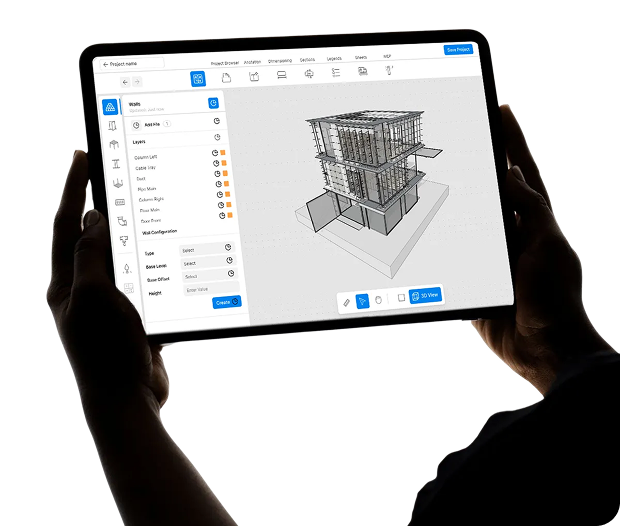
How a UX Redesign Made Navigation 65% Faster and Doubled Demo Interactions
MEP engineering services & construction tech
Website Design and Development for a Modern Coliving Brand
Coliving Shared Spaces+58%
Lead conversion
How We Built a Coliving Marketplace and Property Operations Platform
Coliving4%
higher occupancyGuides paired with commercial real estate ERP software
Long-form reading on the disciplines that pair with a commercial ERP build. Every guide goes deeper on what actually works, what breaks, and what to build against.
- Pillar guide
Custom Real Estate CRM Development
How commercial deal cycles run: pipeline stages, broker commissions, lease abstract workflows, and CRM configuration for CRE.
Read guide - Pillar guide
Real Estate Website Development
How commercial leasing websites differ from residential: filters by SF and use class, tenant portals, and broker access flows.
Read guide - Pillar guide
Real Estate SEO & AEO
How commercial tenants and brokers research space on Google and AI answer engines. The keyword surface for ERP-adjacent queries.
Read guide - Pillar guide
Real Estate App Development
Where tenant experience apps earn their keep in commercial: building access, amenities, maintenance, sustainability reporting.
Read guide - Pillar guide
Real Estate Branding & Design
How brand signals building class, tenant tier, and portfolio grade. What the ERP data ultimately supports for enterprise tenants.
Read guide - Pillar guide
Real Estate Digital Marketing & Lead Generation
How commercial marketing tunes for enterprise tenants and brokers. LinkedIn ABM and content that positions the operator.
Read guide
Diagnostics for commercial real estate operators
Calculators and self-diagnostics your team can run before, during, and after an ERP migration. All free, all built for commercial real estate.
Cap rate calculator
Capitalisation rate from NOI and property value. The standard benchmark for commercial property valuation.
Try the toolNOI calculator
Net operating income from gross rents minus operating expenses. Foundation metric for every commercial lease analysis.
Try the toolDSCR calculator
Debt service coverage ratio for commercial financing. See if property cash flow meets lender requirements.
Try the toolPropTech Readiness Index
Where your tech stack is strong and where it is quietly leaking pipeline. A 10-minute self-diagnostic.
Try the tool
Field notes on commercial ERP and real estate systems
Shorter takes on cost, compliance, and integration patterns from live commercial ERP engagements.
- Website
What does a real estate website cost in 2026? An honest breakdown
USD tiers per asset type, including commercial leasing sites, multi-property portals, and enterprise commercial platforms.
Read insight - Compliance
RERA compliance for project websites. What to display, where, why
Compliance layer that shapes reporting requirements downstream into ERP data models in regulated markets.
Read insight - SEO
SEO for real estate websites in 2026. The operator playbook
Per-listing schema, hyperlocal landing pages, AEO surface. How commercial ERP data feeds the discovery layer.
Read insight
Fresh writing on commercial real estate systems
Every post is a live-engagement field note. New drops appear here automatically.

Why Noseberry Digitals is one of the best real estate mobile app development company in USA
This blog explains why Noseberry Digitals stands out as a real estate mobile app development company, built around a focused history of property and proptech clients rather than general app development. It walks through the seven-phase development process, the native versus cross-platform decision, and the app store compliance work behind a 14-of-16 first-try approval rate. It shares measurable client results, including faster navigation, lower bounce rates, and occupancy gains from real coliving, brokerage, and marketplace projects. It also compares Noseberry against typical generalist agencies on cost, ownership, and post-launch support. The article closes with a 10-question FAQ covering cost, timeline, and technology choices for anyone evaluating a real estate app development partner.

Top 5 Software Development Company for Real Estate in USA: Full Comparison Guide
This blog ranks and compares the top five software development companies for real estate in the USA, starting with Noseberry Digitals and covering Ascendix Technologies, TechAhead, Chetu, and Itransition. It walks through what actually separates a real estate specialist from a general software vendor, including source code ownership, industry focus, and post-launch support. The piece includes a side-by-side comparison table covering headquarters, experience, and specialty for each company. It also breaks down realistic pricing ranges, engagement models, and red flags to watch for before signing a contract. The article closes with a 10-question FAQ section covering selection criteria, costs, and timelines.
PropTech Software Development: How Noseberry Digitals Builds Smarter Real Estate Solutions in USA
This blog explains what proptech software development actually involves and why real estate businesses need purpose-built platforms instead of generic SaaS tools. It covers what to look for in a proptech software development company, from code ownership to pricing structure to documented build timelines. It walks through how Noseberry Digitals runs its six-phase build process, the types of platforms it builds most often, and the compliance awareness baked into that work. The piece includes real case study results, a comparison of in-house, freelance, and agency development models, and common mistakes real estate companies make when choosing a partner. It closes with a direct answer to why choose Noseberry Digitals as a proptech software development agency, backed by verifiable stats rather than marketing claims.
20+ commercial ERP engagements shipped
Scope my commercial real estate ERP build. Reply in 24 hours · 20+ ERP engagements shipped · Data migration and parallel run included.
No commitment · Reply within 24 hours · Join 100+ real estate brands
Commercial real estate ERP software built for multi-asset portfolios · No commitment, reply in 24h.