

Atul Kumar
Real estate & PropTech specialist
What is a REIT and how do REITs operate 2026
Published May 30, 2026|7 min read
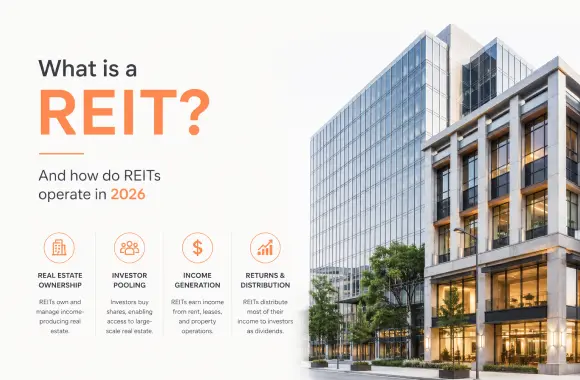
A REIT is a real estate investment trust, a company that owns, operates, or finances income-producing real estate and is required to distribute at least 90 percent of taxable income to shareholders annually. REITs come in three main types: equity REITs that own and operate property, mortgage REITs that finance property through loans and mortgage-backed securities, and hybrid REITs that combine both. REITs can be public and listed on stock exchanges, public but non-listed, or fully private. To qualify as a REIT under IRS rules, a company must invest at least 75 percent of total assets in real estate, earn at least 75 percent of gross income from real estate sources, and pass through nearly all taxable income to shareholders, which is what gives REITs their tax-efficient structure.
What is a REIT in 2026
A REIT, or real estate investment trust, is a company that owns, operates, or finances income-producing real estate. The structure was created so that ordinary investors could access the income and total return potential of large-scale commercial real estate without having to buy, manage, or finance individual properties themselves.
A REIT pools capital from many investors. That capital is then used to acquire and operate a portfolio of properties, or to invest in real estate debt instruments. The income generated by the underlying assets, rents from tenants, or interest from mortgage loans, flows back to shareholders in the form of dividends.
The structure is governed by IRS rules in the United States and similar regulatory frameworks in other markets. The most important rule is the distribution requirement, which requires a REIT to pay out at least 90 percent of taxable income to shareholders, thereby making the REIT structure tax-efficient at the corporate level.
For the authoritative definition of REITs and their structure, [Nareit's industry resource] is the primary global reference.
How do REITs work
A REIT works on a simple operational loop. The REIT acquires income-producing assets, manages them professionally, collects rent or interest income, covers operating costs and debt service, and distributes the remaining taxable income to shareholders.
The mechanics break into four steps:
Step 1: capital formation
A REIT raises capital from investors, either through a public offering on a stock exchange, a non-listed offering, or a private placement.
Step 2: asset acquisition and operation
Capital is deployed into a portfolio of properties or real estate-related debt. Equity REITs lease space to tenants and collect rent. Mortgage REITs originate or purchase mortgages and collect interest.
Step 3: income generation and operational management
The REIT runs the portfolio. Leasing, tenant communication, maintenance, finance, compliance, and reporting are all managed at scale, usually with a dedicated operating platform.
Step 4: distribution
At least 90 percent of taxable income is distributed to shareholders. This is what gives REITs their reliable yield profile and what differentiates them from other corporate structures.
What are the three main types of REITs
REITs fall into three main types based on what they invest in.
Equity REITs
Equity REITs own and operate physical real estate. Their income comes from rent. Typical holdings include office buildings, apartment communities, shopping centres, hotels, healthcare properties, data centres, industrial warehouses, and self-storage facilities. Equity REITs are the largest category by market capitalization globally.
Mortgage REITs
Mortgage REITs do not own physical real estate. Instead, they finance real estate by originating or purchasing mortgages and mortgage-backed securities. Their income comes from the interest spread between the cost of capital they raise and the yield on the loans and securities they hold. Mortgage REITs are more sensitive to interest rate movements than equity REITs.
Hybrid REITs
Hybrid REITs combine elements of both. They own some physical real estate, and they also invest in mortgages and mortgage-backed securities, blending the income profile of both categories.
What are the IRS rules a REIT must follow?
To qualify as a REIT under IRS rules, a company must meet several structural and operational tests every year.
Asset test
At least 75 percent of total assets must be invested in real estate, cash, or US Treasuries.
Income test
At least 75 percent of gross income must come from real estate sources, including rent from real property and interest from mortgages on real property.
Distribution test
At least 90 percent of taxable income must be distributed to shareholders annually as dividends.
Ownership test
A REIT must be owned by at least 100 shareholders, and no more than 50 percent of shares can be held by five or fewer individuals.
Entity test
A REIT must be structured as a corporation, trust, or association that would otherwise be taxable as a domestic corporation.
When a REIT meets these tests, the corporate-level income tax is largely avoided. The shareholders pay tax on the dividends they receive, which means the income is taxed at the investor level rather than twice at both the corporate and investor levels.
What is the difference between public, non-listed, and private REITs
REITs are also categorized by how they are accessed and traded.
Publicly listed REITs
Publicly listed REITs are registered with the SEC and trade on a national stock exchange. They offer daily liquidity, transparent pricing, and full public disclosure. This is the most common and most accessible REIT structure for retail and institutional investors alike.
Public non-listed REITs (PNLRs)
Public non-listed REITs are registered with the SEC but do not trade on a national stock exchange. They follow public reporting requirements but offer limited liquidity, with redemption usually available only at periodic intervals.
Private REITs
Private REITs are exempt from SEC registration and do not trade publicly. They are typically available only to accredited or institutional investors. Liquidity is limited, and disclosure requirements are less stringent than those of public REITs.
Why do investors choose REITs
Investors choose REITs for four reasons.
Income
The 90 percent distribution requirement means REITs typically pay higher dividends than the broader equity market. For income-focused portfolios, this is a structural advantage.
Diversification
REITs give investors exposure to commercial real estate without the operational burden of direct ownership. They also span asset classes that retail investors rarely access directly, including data centres, healthcare facilities, industrial warehouses, and infrastructure.
Liquidity
Publicly listed REITs trade like stocks. An investor can enter or exit a position in seconds, which is a meaningful improvement over the months or years required to transact a private real estate asset.
Long-term return potential
Over multi-decade time periods, REITs have historically delivered competitive total returns from a combination of rental income, asset appreciation, and tax-efficient pass-through.
How do modern REITs operate at a portfolio scale?
A modern REIT operating at portfolio scale runs on three foundations: a unified operating model across every property, a clean data architecture that supports real-time reporting, and a technology stack that scales from one asset class to many.
The 2026 reality is that REITs face higher operational complexity than ever. According to [Deloitte's 2026 Commercial Real Estate Outlook], 61 percent of commercial real estate firms still rely on legacy core technology infrastructure, and nearly half are actively trying to modernize. The REITs that have modernized ahead of peers operate at lower cost per unit, faster reporting cycles, and stronger investor narratives.
[McKinsey and Company] estimates the real estate industry stands to gain between 110 billion and 180 billion US dollars in productivity through automation, with REITs and other large operators capturing a disproportionate share because they have the asset base to absorb the upside.
Modern REIT operations rest on:
A unified property and asset management platform that connects leasing, finance, maintenance, and tenant lifecycle
A data layer that produces NOI, occupancy, and operating cost in real time across every property
Investor-grade reporting that holds up to public market scrutiny
AI and automation across leasing, valuation, tenant communication, and predictive maintenance
A documented operating model that scales as the portfolio grows
For a deeper view of where AI is creating measurable value in real estate operations, our reference piece on [AI in real estate: top 10 applications] walks through the use cases in detail.
How does Noseberry Digitals support REITs
Our [REIT industry practice] sits inside our [real estate consultancy] and combines operating model design, technology strategy, data architecture, and execution support under one engagement.
We help REITs with:
Operating model design across multi-asset and multi-region portfolios
Property and asset management platform modernization through our [custom software development]() capability
Data unification and investor-grade reporting through our analytics and dashboard work
AI and automation rollout through our [custom AI solutions]
[CRM implementation]() for leasing and investor relations
[Systems integration] across finance, asset management, and tenant platforms
The work is sized to the maturity of the REIT, from emerging non-listed REITs scaling toward public market readiness through to listed REITs running multi-billion dollar portfolios across multiple geographies.
- A REIT is a company that owns, operates, or finances income-producing real estate.
- REITs must distribute at least 90 percent of taxable income to shareholders annually.
- The three main types are equity REITs, mortgage REITs, and hybrid REITs.
- REITs can be public listed, public non-listed (PNLRs), or private.
- IRS rules require at least 75 percent of assets in real estate, at least 75 percent of income from real estate sources, and ownership by at least 100 shareholders.
- Investors choose REITs for income, diversification, liquidity, and long-term return potential.
- 61 percent of commercial real estate firms still rely on legacy infrastructure, per Deloitte's 2026 outlook.
- McKinsey estimates 110 to 180 billion US dollars in real estate productivity gains from automation.
- Modern REITs operate on a unified platform, clean data, investor-grade reporting, AI, and a documented operating model.
- A consultancy partner can accelerate REIT modernization across operating model, technology, data, and AI.
Why trust Noseberry
Our content is written by practicing real-estate and PropTech professionals, fact-checked by a dedicated editorial team, and reviewed against the latest industry data before publication.
- 10+ years of industry expertise
- All facts independently verified
- No sponsored rankings in guides
- Updated when the industry changes
Have any questions?
What is a REIT?
A REIT, or real estate investment trust, is a company that owns, operates, or finances income-producing real estate. It is required to distribute at least 90 percent of taxable income to shareholders annually, which gives REITs a tax-efficient structure and a typically high dividend yield.
What are the three main types of REITs?
The three main types are equity REITs that own and operate physical real estate, mortgage REITs that finance real estate through mortgages and mortgage-backed securities, and hybrid REITs that combine both strategies.
What is the difference between a public REIT and a private REIT?
A public REIT is registered with the SEC and either trades on a national stock exchange (public listed) or does not (public non-listed). A private REIT is exempt from SEC registration, does not trade publicly, and is typically available only to accredited or institutional investors.
What IRS rules must a REIT follow?
A REIT must invest at least 75 percent of total assets in real estate, earn at least 75 percent of gross income from real estate sources, distribute at least 90 percent of taxable income to shareholders, be owned by at least 100 shareholders, and be structured as a corporation, trust, or association.
Why do investors choose REITs?
Investors choose REITs for income (high dividend yield from the distribution requirement), diversification (exposure to commercial real estate and adjacent asset classes), liquidity (public REITs trade like stocks), and long-term total return potential.
How do modern REITs operate at portfolio scale?
Modern REITs operate on a unified property and asset management platform, a real-time data layer that powers NOI and occupancy reporting, investor-grade reporting infrastructure, AI and automation across leasing, valuation, and operations, and a documented operating model that scales as the portfolio grows
How can a real estate management consultancy help a REIT?
A real estate management consultancy helps a REIT by combining operating model design, technology strategy, data architecture, and execution support under one engagement, so the operating platform, the reporting layer, and the investor narrative stay aligned as the portfolio scales.
Related insights
 Real Estate
Real estate ad creative and landing pages: the 2026 conversion playbook
Real estate ad creative and landing pages are the two conversion levers that decide whether paid traffic turns into qualified pipeline or wasted spend. In 2026, the strongest operators run short vertical video that shows the actual unit with honest price, location, and possession details in the first three seconds, then send that traffic to a dedicated single-goal landing page rather than a homepage. Done well, this pairing lifts landing-page conversion rates to 8 to 15 percent for high-intent search traffic and cuts cost per qualified lead by 30 to 50 percent, because the creative qualifies the audience before the click and the page removes every reason to bounce after it.
July 17, 2026 Real Estate
Real estate content pillars: how to build and execute your 4–6 pillar topics
Real estate content pillars are the four to six core topics an operator owns and publishes against consistently, each supporting 20 to 50 individual pieces over 24 months. The five pillars that drive the most measurable pipeline in 2026 are market reports, neighbourhood and city guides, buyer and seller education, operator playbooks, and original research. To execute them, assign every planned piece to one pillar, cluster related pieces into topic hubs that internally link to a central pillar page, and publish four to six pieces per month split across pillars. Done properly, a pillar-first structure compounds topical authority and lifts both Google rankings and AI search citation rates, rather than scattering effort across disconnected posts.
July 17, 2026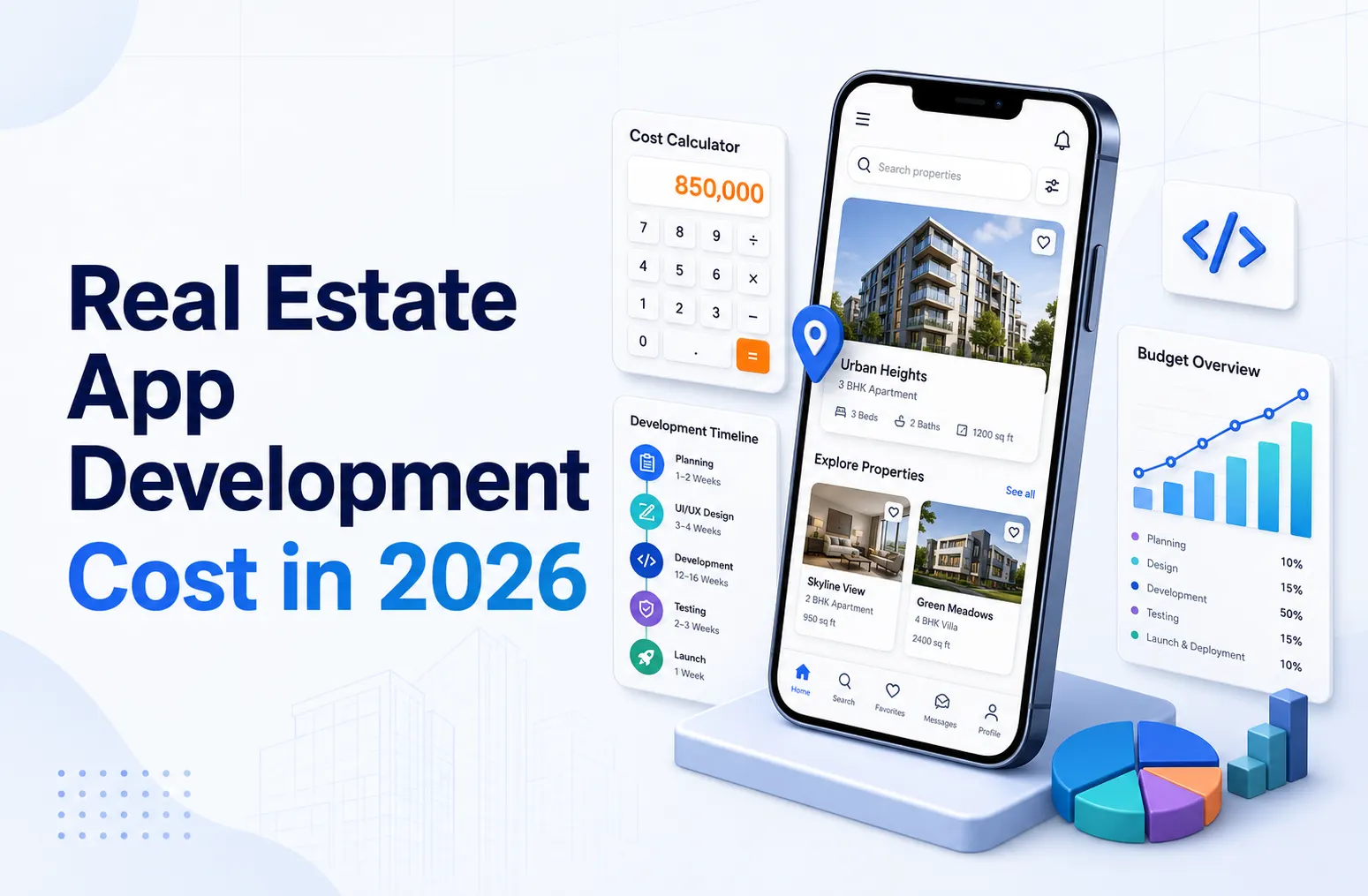 Real Estate
Real estate app development cost in 2026: full guide
Real estate app development in 2026 costs between USD 25,000 and USD 280,000+ depending on scope, platform, and feature depth. A single-platform MVP with basic listing and booking features starts at USD 25,000 to USD 45,000. A cross-platform iOS and Android app with CRM integration, payments, and native listings runs USD 65,000 to USD 140,000. A full property platform or coliving operating system with tenant portal, PMS integration, community features, and AI capabilities costs USD 140,000 to USD 280,000+. Most operators recover the build cost in 8 to 18 months through direct booking uplift and reduced third-party channel commissions.
July 17, 2026
Ready to book a 30-minute strategy call?
We'll map the right digital moves for your real estate business, no pitch deck, no commitment.