

Mayank Pokharna
Real estate & PropTech specialist
REIT operating model and technology stack 2026
Published June 2, 2026|12 min read
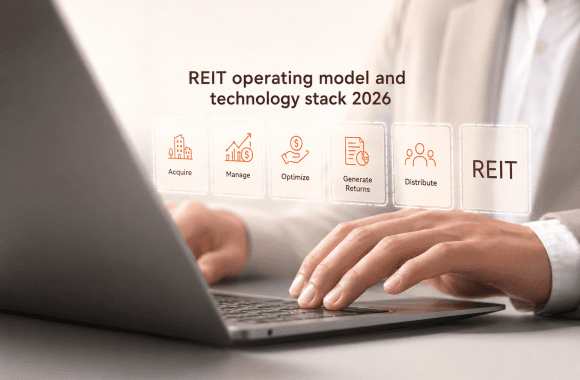
The 2026 REIT operating model rests on a unified property and asset management platform, a centralized data layer producing NOI and occupancy in real time, an investor-grade reporting infrastructure, AI and automation across leasing, valuation, and operations, and a documented governance model that scales as the portfolio grows. The technology stack supporting this model has five core layers: property and asset management, leasing and CRM, finance and capital, data and analytics, and AI and automation. REITs that have built this stack operate at lower cost per unit, faster reporting cycles, and stronger investor narratives than peers still running on legacy systems and fragmented spreadsheets.
What is the modern REIT operating model in 2026
The modern REIT operating model in 2026 is the structured approach a REIT uses to run its portfolio, generate income, manage capital, and report to investors. It is a deliberate design choice, not an accident of growth. The REITs that perform consistently have built their operating model on five principles: a single source of truth across every property, a centralized operations function with clear playbooks, an investor-grade reporting layer, scalable technology that grows with the portfolio, and a measurement framework tied to NOI, occupancy, and operating cost per unit.
A REIT that grew through acquisition without redesigning the operating model usually ends up with five different platforms, three different reporting cadences, and one frustrated CFO. The operating model is what fixes that, and it has to be built deliberately.
For the foundational definition of REITs and how they fit inside the capital markets, Nareit's industry resource remains the global reference.
Why does the operating model matter as much as the asset portfolio
For a REIT, the operating model matters as much as the asset portfolio because investors price the predictability of cash flow as heavily as the quality of the underlying assets. Two REITs with identical portfolios can trade at meaningfully different multiples if one runs on clean operations and the other does not.
The reason is risk perception. Public market investors and institutional allocators model future cash flows under defined risk frameworks. Clean reporting, clean data, and disciplined processes reduce perceived risk, thereby compressing the discount rate applied to future cash flows and lifting enterprise value.
According to Deloitte's 2026 Commercial Real Estate Outlook, 61 percent of commercial real estate firms still rely on legacy core technology infrastructure, and nearly half are actively trying to modernize. The REITs ahead of the curve are not just operating more efficiently. They are also being rewarded with stronger valuations and easier access to capital.
What are the five core layers of the REIT technology stack?
A modern REIT technology stack has five core layers.
Layer 1: property and asset management
The system of record for every property, every lease, every tenant, and every asset-level capital expenditure. This is the operational backbone. Our custom software development work for REITs usually starts here.
Layer 2: leasing and CRM
The platform that manages leads, prospects, lease pipeline, renewals, and tenant communication. A modern REIT runs leasing through a CRM integrated with the operating platform, not through spreadsheets.
Layer 3: finance and capital
Accounting, treasury, capital structure, debt management, and investor distributions. The finance layer integrates with the property and asset management layer so that NOI, capital expenditure, and debt service all reconcile in real time.
Layer 4: data and analytics
A unified data layer that ingests from every other system and powers reporting, dashboards, and predictive analytics. This is where investor-grade reporting and AI use cases get built.
Layer 5: AI and automation
Use cases include automated valuation, predictive lead scoring, tenant communication automation, predictive maintenance, document intelligence, and reporting automation. Our custom AI solutions practice covers this layer end to end.
The layers connect through systems integration, which is where most REIT modernization programs either succeed or stall.
How does data architecture work inside a modern REIT
Inside a modern REIT, data architecture is the single most important determinant of operational quality. If the data is clean and unified, every other layer of the stack works better. If the data is fragmented or duplicated, every layer struggles.
The right data architecture follows four design principles.
Principle 1: a single source of truth per data domain
Property data lives in one place, lease data in one place, and tenant data in one place. No reconciliations at month-end.
Principle 2: real-time integration, not batch
Data flows continuously across systems so that the executive dashboard reflects today, not last month.
Principle 3: a governed data model
Every data field has a defined owner, definition, and update process. Without governance, data quality degrades within months.
Principle 4: investor-grade outputs by design
Every report a REIT publishes externally should be generated from the same data layer that internal management uses. This is what gives investors confidence in the numbers.
What does investor-grade reporting look like for a REIT?
Investor-grade reporting for a REIT covers four categories.
Category 1: financial reporting
Income statements, balance sheets, cash flow statements, capital structure, and distribution coverage are prepared consistently across reporting periods.
Category 2: property and portfolio reporting
NOI by property, by region, by asset class. Occupancy trends. Same-store performance. Lease expiration schedules. Capital expenditure tracking.
Category 3: operational reporting
Collection cycle time, leasing pipeline, tenant satisfaction, maintenance backlog, and operating cost per unit.
Category 4: forward-looking and ESG reporting
Capital deployment plans, growth pipeline, sustainability metrics, and risk register.
The bar is set by public market expectations. Even private REITs that never plan to list benefit from operating at this standard, because institutional investors and capital partners expect it during diligence.
How are REITs using AI and automation in 2026
REITs are using AI and automation in 2026 across the full operating stack. The highest-ROI use cases for REITs include:
Automated valuation models for portfolio revaluation and acquisition screening
Predictive lead scoring for leasing teams managing high volumes of prospects
AI chatbots for tenant communication, query resolution, and renewal nudges
Predictive maintenance to reduce reactive repair costs across the portfolio
AI-assisted document review for lease abstraction and acquisition diligence
AI-driven reporting automation to compress month-end and quarter-end cycles
"For REITs operating at portfolio scale, AI is no longer optional. It is the operating leverage that separates the firms growing margin from the firms watching margin erode," said one institutional REIT operator we worked with in 2026.
For the full set of production-ready AI use cases in real estate, with data on outcomes, our reference piece on [AI in real estate: top 10 applications](https://noseberrydigitals.com/blog/ai-in-real-estate-applications) walks through every use case in detail.
[McKinsey and Company](https://www.mckinsey.com/industries/real-estate/our-insights) estimates the real estate industry stands to gain between 110 billion and 180 billion US dollars in productivity through automation. REITs and other large operators capture a disproportionate share because they have the asset base to absorb the upside.
What are the most common operating model mistakes REITs make
Four mistakes appear repeatedly across stalled or underperforming REITs.
Mistake 1: growing through acquisition without integrating the operating model
Each new portfolio comes in with its own systems and processes. Without active integration, the REIT ends up running multiple operating models in parallel, which kills margin and confuses investors.
Mistake 2: investing in technology without redesigning the operating model
A new property and asset management platform installed on top of a fragmented operating model usually mirrors the old problems at a higher cost.
Mistake 3: under-investing in the data layer
Data is the foundation of every other layer. REITs that skip the data work end up with beautiful dashboards built on numbers no one trusts.
Mistake 4: treating investor reporting as a finance project
Investor-grade reporting depends on operations, technology, data, finance, and ESG working together. A pure finance project misses the operational reality that the numbers describe.
How does Noseberry Digitals help REITs build the operating model and tech stack?
Our [REIT industry practice](https://noseberrydigitals.com/industries/reits) sits inside our [real estate consultancy](https://noseberrydigitals.com/services/real-estate-consultancy) and runs in four phases.
Phase 1: diagnostic across the operating model, technology, data, and reporting
Phase 2: future state design with written operating model, technology stack architecture, and data layer blueprint
Phase 3: execution through our delivery teams across custom software development, CRM implementation, systems integration, and custom AI solutions
Phase 4: measurement and refinement against KPIs tied to NOI, occupancy, operating cost per unit, and reporting cycle time
We work with REITs across the United States, India, and the Middle East, from emerging non-listed REITs scaling toward public market readiness through to listed REITs running multi-billion dollar portfolios.
- The modern REIT operating model rests on a unified platform, centralized operations, investor-grade reporting, scalable technology, and a clear measurement framework.
- For REITs, the operating model influences valuation as much as the asset portfolio because investors price the predictability of cash flow.
- The five core layers of the REIT technology stack are property and asset management, leasing and CRM, finance and capital, data and analytics, and AI and automation.
- 61 percent of commercial real estate firms still rely on legacy infrastructure, per Deloitte's 2026 outlook.
- A single source of truth per data domain is the most important architectural principle.
- Investor-grade reporting spans financial, property, and portfolio, operational, and forward-looking ESG categories.
- High-ROI AI use cases for REITs include valuation, lead scoring, tenant chatbots, predictive maintenance, document review, and reporting automation.
- McKinsey estimates 110 to 180 billion US dollars in real estate productivity gains from automation.
- Common mistakes include acquiring without integrating, technology without process redesign, under-investing in data, and treating reporting as a finance-only project.
- A consultancy partner combines diagnostic, operating model design, technology delivery, and measurement under one engagement.
Why trust Noseberry
Our content is written by practicing real-estate and PropTech professionals, fact-checked by a dedicated editorial team, and reviewed against the latest industry data before publication.
- 10+ years of industry expertise
- All facts independently verified
- No sponsored rankings in guides
- Updated when the industry changes
Frequently Asked Question?
What is the modern REIT operating model?
The modern REIT operating model is the structured way a REIT runs its portfolio, generates income, manages capital, and reports to investors. It rests on a unified platform, centralized operations, investor-grade reporting, scalable technology, and a measurement framework tied to NOI, occupancy, and operating cost per unit.
What are the layers of a REIT technology stack in 2026?
A modern REIT technology stack has five core layers: property and asset management, leasing and CRM, finance and capital, data and analytics, and AI and automation. The layers connect through systems integration to form a unified operating platform.
Why does the operating model influence REIT valuation?
The operating model influences REIT valuation because investors price the predictability of cash flow as heavily as the quality of the assets. Clean reporting, clean data, and disciplined processes reduce perceived risk and lift enterprise value.
How is data architecture designed inside a modern REIT?
Inside a modern REIT, data architecture follows four principles: a single source of truth per data domain, real-time integration, a governed data model, and investor-grade outputs generated from the same data layer used internally.
How are REITs using AI in 2026?
REITs in 2026 are using AI for automated valuation, predictive lead scoring, tenant chatbots, predictive maintenance, AI-assisted document review and lease abstraction, and reporting automation. The highest-ROI use cases sit in operations, leasing, and finance.
What are the most common REIT operating model mistakes?
The most common mistakes are growing through acquisition without integrating the operating model, investing in technology without redesigning the operating model, under-investing in the data layer, and treating investor reporting as a pure finance project.
How can a real estate management consultancy help a REIT modernize?
A real estate management consultancy helps a REIT by combining diagnostic, operating model design, technology stack architecture, data layer blueprint, and execution support under one engagement, so the strategy and the system stay aligned end to end.
Related insights
 Real Estate
Real Estate Digital Agency in USA: How Noseberry Digitals Helps Developers & PropTech Companies Grow
This blog explains what makes Noseberry Digitals a real estate digital agency in USA built for developers and proptech companies. It covers why generalist agencies struggle with real estate-specific needs like MLS integrations and multi-market brand consistency. It walks through the agency's full-stack services, from branding and websites to CRM, AI, and a 60-day proptech MVP program. It highlights named, documented case studies with real client results, something the piece notes is rare among proptech marketing agencies. It closes with a practical checklist for choosing a real estate digital agency and clears up whether Noseberry Digitals is itself a proptech company.
August 27, 2026 Real Estate
PR Strategy for PropTech Startups: Earning Press and Investor Attention Before You Raise
This blog lays out a pre-raise PR playbook for proptech founders built around timing, not volume, of press coverage. It explains why research shows more media mentions can actually backfire past a certain threshold, and why narrative quality beats raw mention count with investors. It covers how investors actually use press coverage during due diligence, and what they're typically searching for before a first call. It walks through a practical three-to-six-month PR timeline, plus which trade outlets matter most for real estate versus general tech press. It closes with a DIY versus agency comparison, common PR mistakes that sink fundraising, and a 10-question FAQ section.
August 26, 2026 Real Estate
Smart Home and IoT Integration for Property Operators: Cost, ROI, and What to Build First
This blog breaks down smart home and IoT integration for property operators, covering real costs, real ROI, and exactly what to build first. It walks through actual pricing by portfolio size, from new construction to full enterprise retrofits. It explains where the ROI really comes from, including energy savings data from a major retrofit case study and renter demand statistics. It lays out a staged build order, starting with access control and climate sensors before predictive maintenance, security, and tenant apps. It closes with a data privacy and security checklist, a DIY versus integration partner comparison, and a 10-question FAQ section.
August 24, 2026
Ready to book a 30-minute strategy call?
We'll map the right digital moves for your real estate business, no pitch deck, no commitment.