Scaling Growth Marketing for a Riverside Residential Launch. ₹7L+ in Managed Ad Spend, 6,500+ Qualified Leads in 4 Months
OVERVIEW
ETH Infra is a real estate developer founded in 2013, operating across India's most scenic and spiritually resonant landscapes. With a brand philosophy of "Beyond Addresses, We Build Legacies," the company has delivered seven landmark projects across Haridwar, Neemrana, and Ranikhet, and has been recognized as Developer of the Year 2023, Haridwar One Project of the Year 2024, and Second Home Project of the Year 2023.
Haridwar One is ETH Infra's flagship riverside residential project, positioned around the proposition of "Ganga ke Paas, Shrestha Awas." Phase 1, comprising 56 units, has been successfully delivered with active resident occupancy and an operational clubhouse. The project sits in the second-home and spiritual-tourism segment, a market driven by a geographically dispersed buyer base spanning NCR investors, NRIs, retirement-home seekers, and spiritual-second-home buyers.
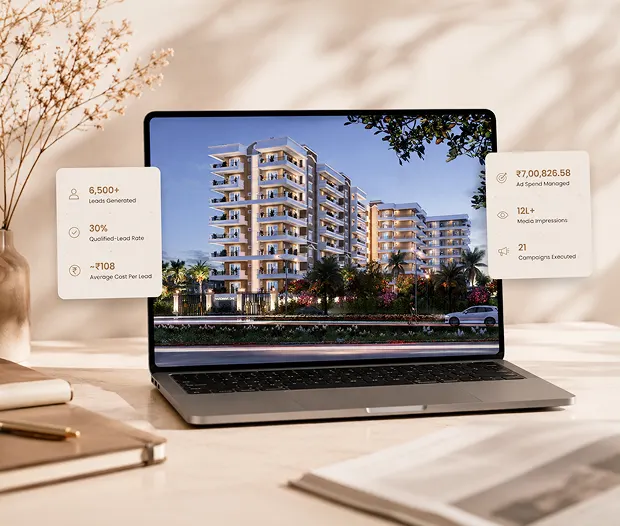
The engagement focused on building a sustained growth marketing system to support continuous inventory release across a four-month launch window. The brief was not a single launch burst but ongoing, scalable lead generation, treating paid acquisition as a continuous performance loop rather than a fixed-duration campaign. Total managed ad spend across the engagement: ₹7,00,826.58.
THE CHALLENGE
Demand for second homes in Haridwar exists, but several structural conditions of the market made single-burst launch campaigns insufficient for the project's pipeline requirements.
KEY CHALLENGES INCLUDED:
A geographically dispersed buyer base (NCR investors, NRIs, retirees, spiritual-second-home buyers) sitting outside any single local broker network
Multiple distinct buyer cohorts requiring different creative, messaging, and audience treatment within the same project
A continuous four-month inventory release window requiring sustained ad presence rather than a one-time launch
High audience-fatigue risk across an extended campaign window
A persistent need to separate genuine high-intent buyers from spiritual-curiosity traffic that the Haridwar location naturally attracts at the top of the funnel
The core challenge was not awareness creation. It was running paid acquisition as a continuous growth marketing system, maintaining qualified lead flow and CAC discipline as cumulative spend scaled across an extended window.
THE OBJECTIVE
The engagement was guided by two interrelated growth marketing objectives that had to be held in balance throughout the campaign window.
The first objective was to sustain consistent lead volume across multiple inventory release dates, ensuring the sales team had a predictable pipeline of fresh leads to work through during each launch wave. This required campaign architecture that supported repeated wave-based execution rather than a single burst, with experimentation velocity built into every wave.
The second objective was to preserve a qualified-lead rate of 30% or higher across the full window. As cumulative spend scales in performance campaigns, the default outcome is for lead quality to degrade. The engagement was structured to actively counter this through audience precision, intent-qualifying lead forms, and disciplined within-wave optimization.
Together, these objectives required a growth marketing model that balanced wave-based volume with audience-level precision, protecting both the top-of-funnel lead count and the cost-per-qualified-lead economics that determine campaign ROI.
THE SOLUTION
The solution was designed as a wave-based growth marketing architecture: continuous performance loops with parallel audience splits inside each loop, rather than a linear, single-audience campaign repeated over time.
MARKET-INFORMED FOUNDATION
Research preceded execution. The Haridwar second-home buyer was mapped into distinct cohorts (investor profile, NRI buyer, retirement-home buyer, and spiritual-second-home buyer), each with different motivations, messaging triggers, and price sensitivities. Seasonal demand cycles tied to spiritual festivals and year-end investment windows were factored into the wave calendar so that launch dates aligned with naturally elevated buyer interest.
LAUNCH WAVE ARCHITECTURE (CORE GROWTH LOOP)
Seven launch waves were executed across the four-month window, on the dates 4 October, 7 November, 27 November, 6 December, 9 December, 14 January, and 21 January. Each wave was structured with three parallel ad sets, labelled ADD 1, ADD 2, and ADD 3, running simultaneously under the same wave. The three ad sets within each wave carried different audience and creative variations, enabling within-wave performance comparison and rapid optimization without waiting for end-of-wave results.
This structure turned every wave into a self-contained growth experiment with its own internal A/B learning. Cumulative learnings from earlier waves then informed the audience targeting, creative direction, and budget allocation of subsequent waves, creating a compounding learning loop across the four-month engagement.
CREATIVE AND AUDIENCE ITERATION
Each successive wave introduced refreshed creative to combat fatigue, while best-performing creatives from earlier waves were retained as control units. Underperforming creatives and audience sets were retired wave by wave. Budget was continuously reallocated toward the ad sets demonstrating both lead volume and lead quality; underperformers were paused early rather than allowed to consume full wave budget.
QUALITY-FIRST LEAD GATING (PROTECTING CAC)
Lead forms were structured with intent-qualifying questions placed at the entry point, so unqualified leads were filtered before reaching the sales team's call queue. This preserved the 30% qualified-lead rate target across the full ₹7L+ spend window, protecting cost-per-qualified-lead economics as gross lead volume scaled.
OPERATING RHYTHM
The execution settled into a repeatable growth marketing rhythm:
Wave launch with three parallel ad sets
Mid-wave performance review and budget reallocation
End-of-wave creative and audience review
Next-wave preparation incorporating cumulative learnings
Continuous daily lead handover to the sales team
THE IMPACT
The wave-based growth marketing architecture delivered consistent lead flow while preserving lead quality across the full four-month window, despite scaling cumulative ad spend to ₹7L+.
KEY OUTCOMES INCLUDED:
Continuous lead pipeline across seven launch waves with no demand gap between waves
30% qualified-lead rate sustained throughout, despite increasing cumulative spend
Audience fatigue avoided through structured wave-based creative refresh
Cumulative audience and creative learnings compounded across waves
Predictable lead volume that allowed the sales team to align inventory release with confirmed pipeline
QUANTIFIED IMPACT:
₹7,00,826.58 total managed ad spend (the headline credibility metric)
6,500+ leads generated across the four-month window
30% qualified-lead rate (QFL) sustained across all waves
12L+ media impressions delivered
21 campaigns executed across 7 launch waves
~₹108 average cost per lead (CPL)
4 months of continuous growth marketing execution (October 2024 to January 2025)
Overall, the engagement demonstrates how growth marketing principles (continuous experimentation, audience layering, CAC discipline, and compounding learnings) can be operationalized inside residential real estate paid acquisition to sustain qualified lead volume across extended inventory release periods without quality degradation.
CONCLUSION
This engagement illustrates what growth marketing looks like when applied to residential real estate paid acquisition. ₹7,00,826.58 in managed Meta Ads spend, deployed across a wave-based launch architecture with parallel audience splits and disciplined creative iteration, generated 6,500+ leads at a ~₹108 cost per lead while sustaining a 30% qualified-lead rate across four months. By treating each launch wave as a self-contained growth experiment with compounding learnings carried forward, ETH Infra's Haridwar One project achieved a predictable, high-quality pipeline that supported continuous inventory release throughout the launch window, which is the operational outcome that growth marketing is built to produce.
Ready to book a 30-minute strategy call?
We'll map the right digital moves for your real estate business, no pitch deck, no commitment.
No slides. No sales pitch. Just a focused strategy call.