

Honey Saxena
Digital Marketing Expert
Luxury Real Estate Social Media Marketing 2026
Published July 22, 2026|12 min read
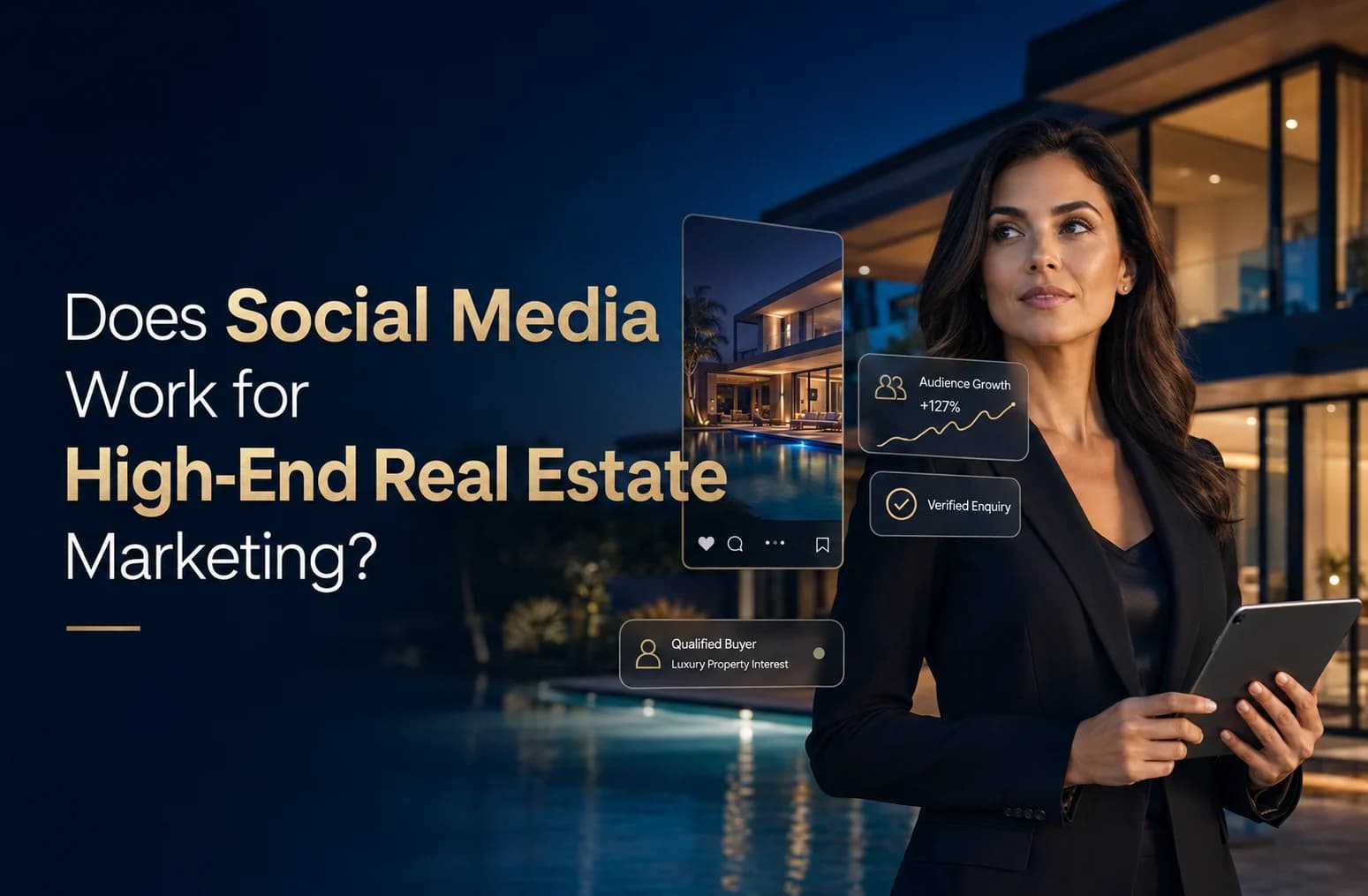
Yes, social media works for high-end real estate marketing when it is used to build desirability, credibility and qualified relationships rather than simply generating maximum reach. Luxury buyers use Instagram, YouTube, TikTok, LinkedIn and private digital networks to discover properties, research locations and evaluate agents, but converting that attention requires premium content, careful targeting and personalised follow-up.
Why does social media work for luxury real estate?
Social media works for luxury real estate because it allows buyers to experience the property, location and lifestyle before arranging a private viewing.
High-end property decisions are rarely based on specifications alone. Buyers consider architecture, privacy, prestige, neighbourhood character, views, interior design, amenities and the emotional experience associated with ownership. Visual and video-led social platforms can communicate these qualities more effectively than a traditional property listing.
Coldwell Banker Global Luxury research found that 73% of affluent consumers had been influenced by social media when considering the purchase of a particular dream home. Instagram and YouTube each influenced 45% of the surveyed luxury consumers, while TikTok influenced 44%. Coldwell Banker Global Luxury
Social media also allows luxury agents and developers to reach potential buyers before those buyers begin actively searching on property portals. A user may initially discover a neighbourhood, architectural style or branded development through video and then move into a more serious research process.
However, social media is most valuable when it supports a complete marketing system. A beautiful Reel without a clear next step, qualified audience or follow-up workflow may attract attention without producing a meaningful sales opportunity.
What makes luxury property marketing different?
Luxury real estate marketing is not ordinary property marketing with more expensive photography. It requires a different approach to audience, presentation, distribution and client experience.
The audience is smaller
A luxury property may be affordable to only a narrow group of qualified buyers. Large audience numbers can therefore be misleading.
The decision is more complex
Affluent buyers may consider tax implications, ownership structures, international mobility, privacy, security, education, investment potential and portfolio diversification.
The property is part of a lifestyle
The value may include access to a waterfront, golf course, cultural district, business centre, wellness environment or private community.
Trust is essential
The buyer needs confidence in the agent, developer, legal structure and accuracy of the information being presented.
Discretion can be more important than publicity
Some owners and buyers do not want a property publicly exposed. The campaign may need controlled distribution, private landing pages, qualified access and direct introductions.
A luxury strategy should therefore balance reach with exclusivity. The objective is not to make the property feel inaccessible, but to protect its value and present it to the right audience.
Which social media platforms work for luxury real estate?
The best platform depends on the property, audience, market and campaign objective. Luxury brands should not publish identical content across every channel.
How does Instagram support luxury property discovery?
Instagram works well for high-quality photography, Reels, carousels, Stories and agent branding.
Use Instagram to present:
Cinematic property walkthroughs
Architectural details
Interior materials and finishes
Neighbourhood experiences
Views and outdoor spaces
Designer collaborations
Construction progress
Private viewing announcements
Agent expertise
Client success stories
A luxury Instagram account should resemble a curated editorial publication rather than a catalogue of repetitive sales graphics.
Reels can create initial awareness, while carousels can explain floor plans, locations, investment context and property details. Stories can support more immediate actions such as viewing availability, event invitations and direct conversations.
How does YouTube build confidence?
YouTube gives agents and developers more time to explain the property and establish authority.
Suitable videos include:
Full property tours
Neighbourhood documentaries
Architect interviews
Developer stories
Market analysis
Investment discussions
Interior design features
Buyer guides
Relocation content
Construction updates
YouTube content can also appear in Google search results and remain discoverable for longer than most short-form social posts.
A high-end tour should not simply move from room to room. It should explain why the design matters, how the home flows, what the views offer and who the property is suited to.
Does TikTok work for luxury real estate?
TikTok can work, particularly when targeting younger affluent buyers, founders, creators and the next generation of family wealth. The content still needs to feel credible and premium.
According to Coldwell Banker’s research, 68% of consumers aged 18 to 24 were most likely to have been influenced by TikTok when deciding on their desired home. This suggests that short-form video can influence luxury aspirations and early property discovery.
Use TikTok for:
Short property reveals
Unusual architectural features
Luxury market explanations
Neighbourhood comparisons
“What this budget buys” videos
Behind-the-scenes access
Property myths
Agent-led educational content
Avoid trends that make the property or brand feel disposable. Participation in a trend should still support the positioning of the listing and agent.
How does LinkedIn support luxury marketing?
LinkedIn can help reach business owners, executives, investors, family office professionals and corporate relocation partners.
Useful LinkedIn content includes:
Luxury market reports
Investment insights
Development announcements
Economic and infrastructure updates
Case studies
Project milestones
Branded residence trends
Commercial opportunities
Professional partnerships
LinkedIn may produce less visible engagement than Instagram, but the audience can include high-value decision-makers and professional referral sources.
What role do private digital channels play?
Private channels often become more important as a prospect moves closer to a decision.
These include:
WhatsApp
Email
Private video links
Password-protected property pages
Invitation-only digital brochures
Virtual consultations
Private investor groups
CRM-based personalised updates
Public social media creates interest. Private communication creates the controlled experience needed to progress serious buyers.
What content works best for high-end real estate?
Luxury content should make the audience feel the quality of the property while providing enough substance to justify its positioning.
Cinematic property films
Show the property through a structured narrative. Begin with a strong visual moment, establish the location and then reveal spaces naturally.
Use restrained camera movement, professional colour correction and carefully selected music. Drone footage should clarify the setting and scale, not exist only for spectacle.
The NAR 2025 Technology Survey found that 52% of REALTORS® used drone photography or video, demonstrating how established elevated visual content has become in real estate marketing. National Association of REALTORS®
Architectural storytelling
Explain:
Who designed the property
Why certain materials were selected
How light moves through the home
How the landscape connects with the architecture
What makes the floor plan distinctive
Whether the home has historical or cultural relevance
This gives buyers a reason to value the property beyond its size.
Lifestyle and location content
A luxury property is often purchased partly because of its environment.
Show:
Restaurants and private clubs
Schools and universities
Art, culture and entertainment
Marinas and golf courses
Wellness facilities
Business districts
Transport connections
Natural surroundings
Security and privacy
Community character
Location content can also attract buyers who are researching an area before they know which property they want.
Agent-led expertise
Luxury buyers and sellers evaluate the person representing the property. Agents should appear in content and demonstrate expertise.
Topics can include:
How luxury homes are valued
What high-net-worth buyers prioritise
How off-market transactions work
How international buyers purchase property
What sellers should disclose
How private viewings are managed
Which property features protect long-term value
Professional knowledge creates trust more effectively than repeatedly describing every listing as exclusive.
Social proof
Use:
Client testimonials
Completed transaction stories
Press features
Awards
Developer credentials
Previous projects
Buyer and seller case studies
Relevant market experience
Protect client confidentiality. Never publish transaction information or identities without permission.
How should luxury content look and sound?
Premium does not automatically mean dark colours, gold text, dramatic music or elaborate transitions. These elements can become predictable when applied without connection to the property.
Luxury content should feel:
Considered
Specific
Calm
Confident
Accurate
Visually consistent
Editorial
Well-produced
Use fewer claims and stronger proof. Replace “unmatched luxury” with specific details about the materials, view, designer, location or service.
For example:
Generic:
“Experience unmatched luxury in the heart of the city.”
More persuasive:
“A private three-bedroom residence overlooking Hyde Park, with full-height glazing, a residents-only wellness floor and 24-hour concierge service.”
The second version allows the audience to understand why the property is premium.
How can luxury agents build a personal brand?
In high-end property, the agent’s personal brand can be as important as the brokerage brand. Sellers want someone who can present the asset properly, protect confidentiality and reach suitable buyers.
An effective personal brand should communicate:
Market specialisation
Local knowledge
Professional standards
Access to qualified networks
Negotiation ability
Communication style
Marketing quality
Transaction experience
NAR reports that 75% of REALTORS® use social media, making it one of the profession’s most widely used technologies. The same research found that 82% of agents said clients responded positively or very positively to technology in the buying and selling process. NAR Technology Survey
Agents should publish more than listings. A stronger content mix includes:
30% property and portfolio content
25% market and location expertise
20% educational content
15% personal and behind-the-scenes content
10% testimonials and business proof
This combination builds familiarity without making the account feel like a continuous advertisement.
How should paid social media be used?
Paid social media should extend the reach of strong content and create controlled conversion paths.
Start with the correct objective
Possible campaign objectives include:
Qualified property enquiries
Private viewing requests
Brochure access
Investor consultations
Development launch registrations
Event invitations
Retargeting engaged prospects
Seller valuation enquiries
Qualify through the message
Include enough information to discourage unsuitable enquiries:
General location
Starting price
Property category
Completion or possession status
Buyer profile
Viewing process
Hiding all relevant information may increase lead volume while reducing quality.
Use staged remarketing
A buyer may not enquire after seeing one video. Build sequences for people who:
Watched a property video
Visited the landing page
Viewed several property pages
Downloaded a brochure
Opened an email
Started but did not complete an enquiry
Previously contacted the business
The second message should add information, not simply repeat the first advertisement.
Follow housing advertising rules
Luxury status does not exempt a campaign from housing advertising regulations. On Meta, real estate advertisements may need to be declared under the Housing Special Ad Category, which can limit certain targeting options.
Campaign teams should review current platform rules and local fair housing, privacy and advertising requirements before launch.
What should a luxury property landing page include?
Social media should direct interested users to a dedicated property experience rather than a generic homepage.
The landing page should include:
A clear property proposition
Premium photography and video
Location context
Property specifications
Floor plans
Architectural or design details
Amenities and services
Developer or seller credentials
Investment context where appropriate
Privacy information
A private viewing or consultation form
Direct contact options
The visual standard of the landing page must match the campaign. A cinematic advertisement leading to a slow, cluttered or poorly designed page immediately reduces trust.
Read Noseberry Digitals’ real estate advertising and landing-page playbook for a detailed conversion framework.
How do calculators support luxury property marketing?
Calculators provide rational support for a purchase that may initially be driven by emotion.
Luxury investors may want to estimate:
Potential ROI
Rental yield
Financing costs
Cash flow
Property taxes
Currency implications
Purchase affordability
Rent versus buy outcomes
An agent can include a calculator within an investment guide, property page or follow-up message. This gives serious buyers a useful next step and helps distinguish them from casual viewers.
Noseberry Digitals offers a free real estate ROI calculator alongside mortgage, rental yield, valuation and cash-flow tools.
Calculators should not replace professional financial, tax or legal advice. They should be positioned as preliminary decision-support tools.
How should social media leads be handled?
Luxury leads should not enter a generic high-volume sales workflow.
The initial response should be timely, professional and relevant to the prospect’s enquiry. Collect enough information to understand:
Property of interest
Preferred location
Budget range
Purchase purpose
Buying timeframe
Financing position
Preferred communication channel
Requirement for privacy
Need for relocation or advisory support
A CRM should record the original content, platform, advertisement and property that generated the enquiry. This allows the sales team to personalise the conversation and helps marketing understand which campaigns create real opportunities.
NAR found that 39% of surveyed agents identified social media as the technology source generating their highest number of quality leads, compared with 23% for CRM and 12% for digital advertising campaigns. National Association of REALTORS®
This does not mean social media automatically produces luxury buyers. It demonstrates that social media can contribute meaningfully when it is supported by professional qualification and follow-up.
How should performance be measured?
Luxury campaigns should not be evaluated primarily through followers, views or total leads.
Track metrics across three levels.
Awareness metrics
Reach within target markets
Video completion rate
Saves
Shares
Profile visits
Branded search growth
Consideration metrics
Property-page visits
Repeat visits
Brochure requests
Floor-plan views
Calculator usage
Email subscriptions
Direct messages
Commercial metrics
Qualified enquiries
Private viewing requests
Consultations
Cost per qualified lead
Viewing-to-offer rate
Offer-to-sale rate
Pipeline value
Revenue by source
One qualified buyer can be more valuable than thousands of low-intent interactions. Reporting should therefore connect social engagement to CRM and transaction outcomes.
What are the most common luxury social media mistakes?
Trying to maximise lead volume
A large number of inexpensive enquiries can overwhelm the team without creating serious opportunities.
Better approach: Optimise for qualified consultations and viewings.
Using generic luxury language
Words such as premium, exclusive and iconic lose impact when they are not supported by evidence.
Better approach: Describe specific design, location and service advantages.
Showing only the property
Buyers also need context about the area, agent, ownership experience and investment case.
Better approach: Build a complete property narrative.
Overproducing every video
Heavy effects can distract from the asset and make the marketing feel less credible.
Better approach: Use high production quality with restrained execution.
Publishing without a conversion path
A user becomes interested but cannot easily request further information.
Better approach: Connect every campaign to a suitable landing page and next action.
Treating every luxury buyer as identical
A primary-home buyer, investor, international purchaser and second-home buyer have different motivations.
Better approach: Create separate messages and follow-up journeys.
Ignoring privacy
Publishing client details, private spaces or sensitive property information can damage trust.
Better approach: Agree on content permissions and access controls before production.
How does social media fit into a complete luxury strategy?
Social media should work alongside:
Brand strategy
Premium website design
Search engine optimisation
Public relations
Email marketing
Paid search
Property portals
Broker relationships
Private networks
CRM automation
In-person events
Direct sales follow-up
Noseberry Digitals’ digital marketing services for real estate connect content, paid campaigns, SEO, landing pages, CRM and analytics into one acquisition system.
Luxury agents and teams can also explore our real estate brokerage solutions, including agent websites, lead-generation systems, CRM implementation and interactive buyer tools.
For a wider organic strategy, read our guide to real estate content marketing in 2026.
Does social media ultimately sell luxury properties?
Social media rarely completes a luxury transaction by itself. Its primary role is to create discovery, desire, familiarity and trust before the buyer enters a private sales process.
A successful campaign may begin with a Reel, continue through a neighbourhood video and property page, progress into a private consultation and finish through an agent-led transaction.
Social media works when each stage protects the property’s positioning and moves the right prospect closer to a meaningful conversation.
Conclusion
Social media works for high-end real estate marketing because luxury property is visual, emotional and closely connected to identity and lifestyle. It allows agents, brokerages and developers to present the property’s story to buyers who may be located anywhere in the world.
Success requires more than attractive imagery. The strategy needs a precise audience, credible positioning, premium creative, qualified conversion path, CRM tracking and personalised follow-up. When these elements work together, social media becomes a valuable source of awareness, trust and qualified luxury property opportunities.
Find out where your real estate marketing is underperforming
Use Noseberry Digitals’ free Real Estate Marketing Audit to assess your brand, content, paid campaigns, SEO, social presence and lead-nurturing system.
- Social media influences luxury property discovery, but high reach does not automatically mean qualified demand.
- Instagram and YouTube are particularly useful for premium visuals, lifestyle storytelling and virtual property experiences.
- Luxury content should communicate privacy, provenance, location and architectural value, not just features.
- Paid campaigns should prioritise qualified enquiries, consultations and private viewings over cheap leads.
- Social media must connect to a premium landing page, CRM and personalised sales process.
Why trust Noseberry
Our content is written by practicing real-estate and PropTech professionals, fact-checked by a dedicated editorial team, and reviewed against the latest industry data before publication.
- 10+ years of industry expertise
- All facts independently verified
- No sponsored rankings in guides
- Updated when the industry changes
Related insights
 Real Estate
Why Noseberry Digitals is one of the best real estate mobile app development company in USA
This blog explains why Noseberry Digitals stands out as a real estate mobile app development company, built around a focused history of property and proptech clients rather than general app development. It walks through the seven-phase development process, the native versus cross-platform decision, and the app store compliance work behind a 14-of-16 first-try approval rate. It shares measurable client results, including faster navigation, lower bounce rates, and occupancy gains from real coliving, brokerage, and marketplace projects. It also compares Noseberry against typical generalist agencies on cost, ownership, and post-launch support. The article closes with a 10-question FAQ covering cost, timeline, and technology choices for anyone evaluating a real estate app development partner.
September 8, 2026 Real Estate
Top 5 Software Development Company for Real Estate in USA: Full Comparison Guide
This blog ranks and compares the top five software development companies for real estate in the USA, starting with Noseberry Digitals and covering Ascendix Technologies, TechAhead, Chetu, and Itransition. It walks through what actually separates a real estate specialist from a general software vendor, including source code ownership, industry focus, and post-launch support. The piece includes a side-by-side comparison table covering headquarters, experience, and specialty for each company. It also breaks down realistic pricing ranges, engagement models, and red flags to watch for before signing a contract. The article closes with a 10-question FAQ section covering selection criteria, costs, and timelines.
September 7, 2026 Real Estate
PropTech Software Development: How Noseberry Digitals Builds Smarter Real Estate Solutions in USA
This blog explains what proptech software development actually involves and why real estate businesses need purpose-built platforms instead of generic SaaS tools. It covers what to look for in a proptech software development company, from code ownership to pricing structure to documented build timelines. It walks through how Noseberry Digitals runs its six-phase build process, the types of platforms it builds most often, and the compliance awareness baked into that work. The piece includes real case study results, a comparison of in-house, freelance, and agency development models, and common mistakes real estate companies make when choosing a partner. It closes with a direct answer to why choose Noseberry Digitals as a proptech software development agency, backed by verifiable stats rather than marketing claims.
September 7, 2026
Ready to book a 30-minute strategy call?
We'll map the right digital moves for your real estate business, no pitch deck, no commitment.