

Mayank Pokharna
COO, Noseberry Digitals & Industry Expert
How Do You Rank Locally for a New Real Estate Site? Can You Compete with Zillow?
Published July 23, 2026|14 min read
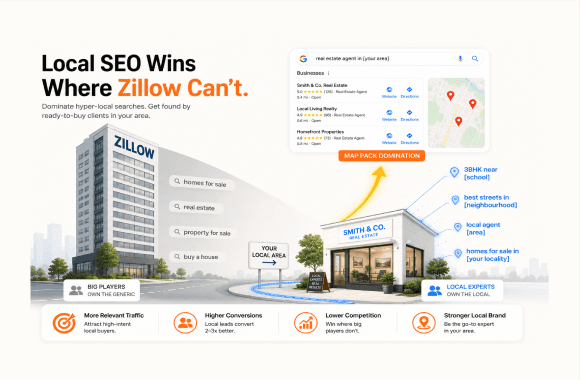
Most new real estate websites try to compete with Zillow on its own terms and lose before they've started. This guide reframes the entire question by showing exactly where national portals are structurally weak, specifically at the neighbourhood and micro-market level, and how a brand new site can outrank them there within 90-180 days using the right local SEO strategies. You'll get a complete content architecture built around topical authority, a month-by-month ranking timeline, the technical fundamentals no new site should launch without, and a practical approach to building local backlinks from zero. It also covers AEO and GEO so your neighbourhood content surfaces in AI answer engines as well as traditional Google results. If you're launching a new property site or an existing site that's invisible in local search, this is the playbook that changes that.
Yes, a brand new real estate website can rank locally and compete with Zillow, but not by targeting the same keywords. The importance of local SEO for new property sites lies in going narrow and deep where national portals go broad and shallow. Zillow dominates "homes for sale." It cannot dominate "3-bedroom apartments near [specific school] in [specific neighbourhood]." That gap is where new sites win, and it is a very large gap.
This is a question I hear from almost every new property client we work with at Noseberry Digitals. They look at Zillow's domain authority (above 90), its billions of indexed pages, and its unlimited content budget, and they conclude that SEO is not worth pursuing. That conclusion is wrong, and it costs them a significant lead source. <cite index="33-1">Zillow alone captures approximately 44% of the total search traffic among top home search portals, effectively cornering the market on broad queries</cite>, but broad queries are not where new agents and independent property businesses win anyway.
The importance of local SEO is that it shifts the entire playing field. Instead of a national domain authority contest you can't win, you're competing in a hyper-local content and credibility race where your genuine knowledge of the area is your actual advantage. This guide gives you the exact strategy, the realistic timeline, and the specific local SEO tactics that move a new site from invisible to visible in 90-180 days.
Why Is Local SEO Important for a New Real Estate Website?
Local SEO is important for a new real estate website because it is the only realistic path to organic visibility when you have no existing domain authority, no backlink profile, and no established rankings to build from. Local SEO targets the specific, location-intent searches where you can win within months, not the national broad terms that require years to compete on.
Here's the strategic logic. A brand new domain starting at zero authority cannot outrank Zillow for "homes for sale." That search returns Zillow, Redfin, Realtor.com, and similar portals that have accumulated 10-20 years of domain authority, millions of indexed pages, and enormous link profiles. Trying to outrank them directly is not a strategy. It's a waste of resources.
But "homes for sale in Jumeirah Village Circle," "2BHK flat near DLF Phase 2 Gurgaon," "apartments for rent Canary Wharf under 2000," or "best estate agents in Altrincham for first-time buyers" are entirely different searches. <cite index="31-1">Neighborhood pages outperform city-level pages because they target lower-competition keywords with higher purchase intent, and they are structurally impossible for national aggregators to create at scale with local expertise.</cite>
That last phrase is the key insight. Zillow and Property Finder can programmatically generate a page for every city. They cannot programmatically generate a page that reads like a local expert wrote it, because they don't have a local expert on staff for every neighbourhood in every city. You do. Or you can become one.
According to BrightEdge's 2025 organic search research, local searches with "near me" intent have grown 150% in the last five years and convert at a significantly higher rate than non-local searches. For real estate, where the product is inherently tied to location, that conversion advantage is even more pronounced. <cite index="33-1">According to the National Association of Realtors, 97% of home buyers use the internet during their property search.</cite> The question for any new real estate site isn't whether to invest in local SEO. It's how fast to build it.
Can You Compete with Zillow? The Honest Answer
You cannot beat Zillow on its own terms, but you don't need to, because Zillow's weakness is your strength. Zillow is a massive programmatic content machine. It generates listing pages, city pages, and market data pages at scale. What it cannot generate is genuine local expertise, community-specific insight, or the trust that comes from a human being with a name and a face who actually knows the streets they're selling.
<cite index="30-1">Google's algorithms now prioritize helpful, experiential content over generic data dumps.</cite> A local boutique agency writing about the "colorful architecture" of a specific street or the "Saturday morning market on the corner that makes this block different from the next one" will outrank a programmatic listing page for that hyper-local search. Google's helpful content updates since 2022 have specifically moved against thin, programmatic content and toward pages with genuine first-hand experience and specific local detail.
Here's a concrete way to think about this. Zillow's page for a neighbourhood typically contains: median list price, recent sales count, average days on market, school ratings, and a list of active listings. Your neighbourhood page can contain all of that plus the specific things only a local expert knows: which streets are quietest, which side of the development gets morning light, what the parking situation is actually like, which amenities opened recently, what local buyers in that area actually care about. That difference, at sufficient depth across enough neighbourhood pages, creates a body of content Google rewards because it genuinely helps users more than Zillow does.
<cite index="30-1">Topical authority is now the number-one ranking factor. Google ranks sites higher if they have 10 or more interconnected articles about a specific neighbourhood, covering schools, pricing trends, local businesses, and commute routes, rather than just one generic landing page.</cite> This is the architecture a new real estate site should build from day one.
What Local SEO Strategies Work for a New Real Estate Site?
The local SEO strategies that work for a new real estate site are: dominating a very small geographical territory first, building your Google Business Profile before any other SEO task, publishing deeply local neighbourhood content consistently, collecting reviews systematically, and building internal links between all your local pages to signal topical authority.
The order matters. Here are the strategies ranked by impact on a new site with zero existing authority:
Strategy 1: Own One Micro-Market Before Expanding
The single most important decision for a new real estate site is geographic scope. If you try to rank for an entire city from day one, you're competing at a level your new domain can't support. If you pick one or two neighbourhoods and publish 10-15 deeply researched pages about those areas specifically, you can achieve topical authority in that micro-market within 3-6 months.
This is the "10x one neighbourhood" strategy. Before you expand to the next suburb or district, you should have on your site: a primary neighbourhood landing page, a schools guide, a market update page, a first-time buyer guide for that area, a rental guide, a commute and transport guide, a local amenities page, and 3-5 blog posts answering specific questions buyers ask about that area. By the time you've published all of that, your site signals to Google that it's the authoritative source for that neighbourhood. Expanding from there carries the authority you've built rather than diluting it.
<cite index="29-1">Hyper-local keywords are your competitive advantage. Generic terms like "homes for sale" send you into a contest you can't win against national portals. Hyper-local phrases combine your service area with property-specific search intent.</cite>
Strategy 2: Google Business Profile Is Your First Priority
Your Google Business Profile (GBP) is the single highest-impact local SEO asset you can control from day one, because it costs nothing, can be fully configured in 48 hours, and directly determines whether you appear in the map pack for local searches before your organic rankings are established.
<cite index="27-1">Your Google Business Profile is the single highest-impact local SEO asset you control. It appears in the Local 3-Pack (map results at the top of search), in Google Maps results, in branded searches for your name, and it generates direct calls and direction requests. It influences local pack rankings more than any other single factor.</cite>
Complete every field in your GBP. Name, address, phone, website URL, business hours, real estate-specific category, service areas, a keyword-rich description, and at least 15-20 high-quality photos. Add your first services listing. Turn on messaging. Post a Google Business Profile update weekly (new listing, market insight, neighbourhood tip). These posts don't carry massive SEO weight but they signal an active, engaged business to Google's local ranking algorithm.
For new sites, GBP can produce local visibility within weeks, long before organic page rankings appear. This is where your first local lead source comes from while you're building content authority.
Strategy 3: Publish Deeply Local Neighbourhood Content
Neighbourhood content is the core of local SEO for real estate because it targets the specific long-tail searches where new sites can rank, and it builds the topical authority that eventually lifts your entire domain in local search results.
A high-quality neighbourhood page for local SEO purposes is not a 300-word description with a listing widget. It is a 1,200-2,000 word resource that answers every question a buyer or renter would have before choosing to move to that area. Based on what consistently ranks, a strong neighbourhood page should cover:
Area overview and character (what the neighbourhood actually feels like, not a generic description)
Current price ranges for different property types (updated at least quarterly)
School catchment areas and ratings for local schools
Transport links and commute times to major employment centres
Local amenities: grocery stores, restaurants, parks, gyms, markets
Recent development and upcoming changes (new builds, infrastructure projects)
Who typically buys or rents here (young professionals, families, investors, retirees)
Local market data: average days on market, price per sq ft trends, supply levels
Each of these sections answers a specific search query someone in the buying or renting research phase will type. Together they create a page that ranks for dozens of long-tail terms simultaneously.
Strategy 4: Build Reviews From Day One, Not as an Afterthought
Reviews are a direct local SEO ranking factor and a conversion signal. For a new site with no review history, getting the first 10 Google reviews is the highest-priority trust-building task outside of content production.
<cite index="27-1">You're not competing with Zillow for "homes for sale." You're competing with other local agents for "homes for sale in your specific neighbourhoods." Your Google Business Profile and the reviews on it are your primary weapon in that competition.</cite>
Ask every client, every referral source, and every collaborator for a review at the moment of highest satisfaction. Make it easy: send a direct link to your GBP review form, not just a generic request to "leave a review somewhere." Reviews with location and property-type keywords ("helped us buy a 2-bed in Clapham Junction") act as keyword signals that reinforce your local relevance.
BrightLocal's 2025 consumer review survey found that 87% of consumers read reviews before choosing a local service. In real estate, where trust is the primary purchase barrier, getting from 0 reviews to 15-20 positive reviews in your first 90 days is one of the most important local SEO wins available.
Strategy 5: Build a Strategic Internal Link Structure
Internal linking is how you transfer the authority you build on high-traffic pages across your entire site, and it's how you signal to Google that your neighbourhood pages form a coherent, interconnected expertise cluster rather than isolated posts.
Your internal link strategy for local real estate SEO should follow a hub-and-spoke model:
Hub: A primary neighbourhood or area page (the anchor content)
Spokes: Blog posts, guides, market updates, and FAQ pages that link back to the hub and to each other
Every new blog post about a neighbourhood links back to the neighbourhood landing page. The neighbourhood landing page links to the schools guide, the market update, and the buying guide. The buying guide links back to the neighbourhood page. Google crawls these connections and builds a picture of your site as a coherent, expert resource on a specific geographic area.
Do not publish orphan pages (pages with no internal links pointing to them). They don't get indexed as quickly and they don't contribute to your topical authority signal. Every page on your site should have at least two inbound internal links.
What Is the Realistic Timeline for Ranking a New Real Estate Site Locally?
A new real estate site can achieve meaningful local visibility in 90-180 days with consistent execution, but the milestones are different at each stage and expecting page-one organic rankings in the first 30 days sets you up for incorrect conclusions about whether the strategy is working.
Here is a realistic month-by-month timeline:
Month 1: Technical foundation and GBP
Launch site with proper technical SEO: schema markup, mobile-first design, sub-2-second load speed, Google Search Console and Analytics 4 connected
Fully configure Google Business Profile
Publish your first 2-3 neighbourhood landing pages (1,200+ words each)
Request first 5-10 Google reviews from existing contacts, past clients, and professional network
Submit site to Google Search Console and request indexing for key pages
Month 2: Content acceleration and citation building
Publish 4-6 additional local content pieces (schools guide, market update, buyer guide for target neighbourhood)
Build local citations (your NAP listed consistently on property portals, local business directories, Chamber of Commerce, industry associations)
Run a small Click-to-WhatsApp or Google Ads campaign targeting your neighbourhood keywords for fast traffic while organic rankings build
Collect 5-10 more reviews
Month 3: First local rankings appear
Long-tail neighbourhood-specific searches begin to rank in positions 5-20
GBP map pack visibility increases for local service searches ("real estate agent near [area]")
Organic traffic from Google Search Console becomes measurable for the first time
Analyse which pages are attracting impressions (even without clicks yet) and expand those topics
Month 4-6: Authority compounds
Consistently ranking in top 10 for target neighbourhood long-tail keywords
Map pack appearances become regular for local searches
Organic leads begin arriving from search
Start expanding content coverage to a second neighbourhood using the same hub-and-spoke model
Build 3-5 quality inbound links from local press, property portals, industry associations, or local business collaborations
<cite index="30-1">A brand new domain typically takes 6-12 months to see significant organic traffic. However, focusing on Tier 2 neighbourhood keywords (specific subdivisions or streets rather than broad city keywords) often produces results in 3-4 months.</cite>
The important shift in mindset: measure impressions and click-through rate from day 30, not just traffic volume. A page ranking in position 8 for a neighbourhood keyword on a new site in month 3 is a meaningful signal of progress, even if the traffic volume is still low.
The Zillow Gap: Specific Keyword Opportunities National Portals Cannot Win
The Zillow gap refers to the large category of local search queries where national portals cannot compete with a genuine local expert, because they lack the on-the-ground knowledge, personal experience, and community-specific depth that these searches reward.
Here's how to find and exploit these gaps systematically:
Step 1: Search your target area in Google and read what the top results actually say. For broad city-level searches, the first page is portals. For neighbourhood-level searches, the picture is different. Many specific neighbourhoods have thin or no dedicated content from any major portal. Those are your entry points.
Step 2: Use Google's "People Also Ask" boxes to find question-based opportunities. These questions represent real searches that currently have weak answers. Questions like "Is [Neighbourhood] good for families?", "What is [Area] like to live in?", "Is [Street/District] safe?" are searches where a well-researched 800-word post by a local expert will outrank a thin portal page.
Step 3: Target "intent modifier + location" combinations that portals miss. National portals generate pages for broad location searches. They rarely generate pages for: "best streets for young professionals in [area]," "new build vs. resale in [neighbourhood]," "is it cheaper to rent or buy in [area] in 2026," or "what's the commute like from [neighbourhood] to [employment hub]." Every one of those is a rankable keyword with real search volume and minimal competition from portal sites.
Step 4: Publish content around local events, infrastructure changes, and market shifts. When a new metro station opens, a major employer relocates nearby, or a new development launches in your area, write about it before anyone else. These timely, locally-specific pieces rank quickly because they target keywords that didn't exist until recently and have no established competitors yet.
AEO and GEO: The New Local SEO Frontier for Real Estate in 2026
AEO (Answer Engine Optimization) and GEO (Generative Engine Optimization) are the practices of structuring your content to be surfaced by AI answer engines like Google's AI Overviews, ChatGPT, Perplexity, and Gemini, because these tools are increasingly the first place buyers go when they ask local property questions.
The importance of local SEO now extends beyond Google's traditional blue-link results. When a buyer asks ChatGPT "what's the best neighbourhood in [city] for young professionals under 30?", the content that gets cited is the content that: states facts clearly, uses structured headings, gives direct answers in the first paragraph of each section, and comes from a domain that covers the topic with consistent depth.
This is exactly the same content architecture that wins local Google rankings. The two strategies reinforce each other. A neighbourhood guide structured for local SEO is simultaneously structured for AEO. Write direct answers below every heading. Use factual, attributable claims. Structure your content in the "X is Y because Z" format wherever you introduce a key point. Make every paragraph function as a self-contained, citable unit.
<cite index="26-1">Voice search is increasingly valuable for local real estate queries. With more buyers asking questions like "best neighbourhoods for families near me," conversational, question-based keywords are now a critical component of real estate local SEO strategy.</cite>
For new real estate sites, AEO creates an accelerated path to visibility. A well-structured neighbourhood FAQ page that clearly answers "What are the schools like in [Area]?" or "What is the average property price in [Neighbourhood]?" can appear in AI-generated responses and Google's featured snippets long before the domain has built enough authority for a page-one organic ranking.
Our SEO and AEO strategy services are built specifically around this dual-track approach, because optimizing for traditional search and AI answer engines requires the same content quality but slightly different structural choices, and doing both simultaneously doubles your surface area for new-site visibility.
Technical Local SEO: What a New Real Estate Site Must Get Right from Day One
Technical local SEO is the foundation that determines whether your content can rank at all, regardless of how well it's written, because a site that loads slowly, isn't indexed correctly, or lacks structured data is effectively invisible to search engines even if the content is excellent.
A new real estate site must have these technical elements in place before publishing a single piece of content:
Non-negotiable technical requirements:
Core Web Vitals compliance: Google uses Largest Contentful Paint (LCP), Cumulative Layout Shift (CLS), and Interaction to Next Paint (INP) as ranking signals. Check your scores at Google PageSpeed Insights before launch. Aim for LCP under 2.5 seconds on mobile.
Schema markup for real estate: Implement LocalBusiness schema (with your address, phone, and geographic coordinates), RealEstateListing schema for listing pages, Review schema where applicable, and Article schema for blog content. Schema tells Google and AI engines exactly what your pages cover.
Mobile-first design: Over 60% of property searches happen on mobile. A site that works perfectly on desktop but poorly on mobile loses the majority of its potential organic traffic.
Google Search Console setup: Connect Search Console from day one. It shows you which queries your pages are appearing for, which pages are indexed, and what technical errors need fixing. Without it, you're flying blind.
Consistent NAP across all platforms: Your business Name, Address, and Phone number must be identical on your website, your GBP, all property portals, and all local directory listings. Inconsistencies in NAP data weaken your local SEO signals.
HTTPS: A basic security requirement. Google deprioritises non-HTTPS sites. Ensure your SSL certificate is active.
XML sitemap submitted to Google: Submit your sitemap through Search Console so Google can find and index all your pages efficiently.
When we build real estate websites at Noseberry Digitals, every technical requirement above is in the baseline specification. None of them are optional extras. They're the floor from which everything else is built.
Local SEO vs. Paid Ads for a New Real Estate Site: What to Prioritise First
For a new real estate site with no organic rankings yet, the most effective approach is running a small paid campaign in parallel with local SEO from month one, because paid ads provide immediate traffic and lead data while organic rankings are building, and that data accelerates the SEO strategy by showing you which keywords actually convert.
Factor | Local SEO (New Site) | Paid Ads |
Results timeline | 90-180 days for first rankings | Immediate (day 1) |
Cost per lead over time | Decreasing as rankings build | Flat or increasing |
Trust signal | High (organic results feel editorial) | Lower (marked as ads) |
Lead quality | High-intent, research-phase buyers | Variable by targeting |
Best use in month 1-3 | Build foundation, publish content | Generate first leads and keyword data |
Best use in month 4+ | Scale content, earn links | Amplify high-converting neighbourhoods |
The practical playbook for a new site:
In months 1-3, spend 60-70% of your marketing budget and time on local SEO (content, GBP, technical setup, reviews) and 30-40% on a targeted Google Ads or Meta campaign for your specific neighbourhood keywords. The ads bring in leads while organic rankings build. The organic traffic data tells you which content to create more of.
By month 6-9, your organic traffic should be producing consistent leads for your primary neighbourhood targets. At that point, you can reduce ad spend in areas where you rank organically and reallocate it to new neighbourhoods where you're still building authority.
Our Google Ads for real estate lead generation post covers how to set up campaigns so your paid traffic feeds keyword and conversion data back into your local SEO strategy rather than running as a completely separate channel.
Building Local Backlinks: How New Real Estate Sites Earn Authority Fast
Backlinks remain one of the strongest signals Google uses to assess domain authority. For a new real estate site, earning even 10-15 quality local backlinks in the first six months can accelerate your rankings significantly compared to publishing content without any link building.
Here are the most realistic link building strategies for a new local real estate site:
Local press and neighbourhood media: Reach out to local newspapers, community blogs, and neighbourhood newsletters with a genuine story angle. A monthly market report for your target area is a linkable asset that local press regularly cites.
Property portal profiles: Most major property portals (Rightmove, Zoopla, Property Finder, Bayut, 99acres, Housing.com) allow agent profile pages with a link back to your website. These are not high-authority links but they're relevant, they contribute to citation signals, and they're free.
Local business partnerships: Estate agents frequently cross-refer with mortgage brokers, solicitors, removal companies, and interior designers. Each of those businesses can link to you from their "local partners" page, producing locally-relevant backlinks.
Community resources and guides: If you create a genuinely useful resource (a complete guide to buying property in [your area] for the first time, including all local solicitor fees, stamp duty calculations, and area-specific advice), local community websites, expat forums, and neighbourhood Facebook groups will often link to it organically once it's been shared.
Industry associations: Join your local or national real estate association and ensure your membership listing includes a link to your site.
None of these tactics require cold outreach to hundreds of websites. They require building genuinely useful content and placing it in front of locally relevant audiences who have a reason to link to it.
For a complete view of how your real estate website, local SEO, paid acquisition, and CRM connect into a single lead generation system, our digital marketing services page covers the full integrated architecture. And our case studies page shows what this looks like in practice for property businesses at different stages.
Conclusion
Ranking locally for a new real estate site and competing with Zillow is not only possible. It's one of the most achievable SEO plays in any industry, precisely because the giants in the space are programmatic content machines that cannot replicate what a genuine local expert with a well-structured site can produce.
The importance of local SEO for new property sites comes down to this single principle: stop trying to win the game national portals play, and start playing a game they structurally cannot win. Hyper-local neighbourhood content, a fully optimised Google Business Profile, systematic review collection, topical authority architecture, and technical SEO fundamentals give a new site a realistic path to first-page visibility in 90-180 days.
The key takeaway: start small, go deep, and compound. Pick one or two neighbourhoods. Own them completely before expanding. Build 10-15 pieces of deeply local content for those areas. Collect 15-20 reviews. Get your GBP to 100% completion. Ensure your technical foundation is solid. Those five actions, executed consistently in the first 90 days, produce results that months of competing on broad national keywords never would.
Here's your immediate next step. Open Google Search Console right now (or create an account if you haven't yet) and submit your site. Then search your primary target neighbourhood in Google and look at the first page results. Count how many are national portal programmatic pages with thin local content. Those are the gaps you're going to fill with content that's genuinely better.
If you want a team to audit your new site's current local SEO standing and map a 90-day action plan specific to your market, Noseberry Digitals works with real estate operators across 14+ countries at every stage from brand new site to established brokerage.
Book a free strategy call atnoseberrydigitals.com and we'll show you exactly which local keywords you can realistically rank for in your first 90 days, and which ones to leave to Zillow.
- The importance of local SEO for new real estate sites is that it shifts competition from national domain authority (which you can't win) to hyper-local content depth (which you can own).
- Zillow captures approximately 44% of total home search portal traffic on broad queries, but programmatic content cannot match genuine local expertise on neighbourhood-specific searches.
- Google's algorithms now reward experiential, locally-specific content over thin programmatic portal pages, creating a structural ranking advantage for genuine local experts.
- Google Business Profile is the single highest-impact local SEO asset for a new site; it can produce local map pack visibility within weeks while organic rankings are still building.
- New real estate sites should target one or two micro-markets first, publish 10-15 deeply local pages per area, and build topical authority before expanding geographically.
- A realistic local SEO timeline: GBP visibility in weeks, first long-tail rankings in months 2-3, consistent organic leads by months 4-6, meaningful authority by months 6-12.
- Topical authority (10+ interconnected pages about the same neighbourhood covering schools, pricing, commutes, and local character) is now the number-one local ranking factor for real estate sites.
- Running small paid ads in parallel with local SEO in months 1-3 provides keyword conversion data that accelerates content decisions while organic rankings build.
- AEO and GEO (optimising for AI answer engines) amplify local SEO by surfacing your neighbourhood content in ChatGPT, Perplexity, and Google AI Overviews, giving new sites a visibility channel beyond traditional blue-link results.
- Local backlinks from property portals, local press, industry associations, and partner businesses (mortgage brokers, solicitors) accelerate authority building significantly compared to content-only strategies.
Why trust Noseberry
Our content is written by practicing real-estate and PropTech professionals, fact-checked by a dedicated editorial team, and reviewed against the latest industry data before publication.
- 10+ years of industry expertise
- All facts independently verified
- No sponsored rankings in guides
- Updated when the industry changes
Have any questions?
What is the importance of local SEO for real estate agents?
Local SEO is important for real estate agents because it puts your website in front of buyers and sellers at the exact moment they're searching for properties or agents in your specific area. Since 97% of home buyers use the internet during their property search (NAR), local search visibility directly determines whether those buyers find you or a competitor. Local SEO is especially important for independent agents because it targets the hyper-specific searches where national portals have thin, programmatic content and genuine local expertise wins.
Can a new real estate website compete with Zillow on Google?
A new real estate website cannot compete with Zillow on broad national search terms. Zillow has decades of domain authority and billions of indexed pages. However, a new site can outrank Zillow on hyper-local, neighbourhood-specific searches within 3-6 months because Zillow's neighbourhood content is programmatically generated and lacks the genuine local depth that Google's algorithms now reward. Focusing on specific neighbourhood keywords with genuine local content is the realistic path to ranking above portal pages.
What are the best local SEO strategies for a new real estate site?
The best local SEO strategies for a new real estate site are: fully completing your Google Business Profile before any other task, publishing deeply local neighbourhood content targeting long-tail keywords national portals ignore, collecting Google reviews systematically from the first week, building a hub-and-spoke internal link structure around each target neighbourhood, ensuring schema markup is in place from launch, and building local citations across property portals and business directories. Starting with one or two micro-markets before expanding produces topical authority faster than spreading content across a wide geographic area.
How long does it take for a new real estate website to rank locally?
A new real estate website typically takes 90-180 days to achieve meaningful local rankings with consistent execution. Google Business Profile visibility can appear within weeks. Long-tail neighbourhood-specific keyword rankings often emerge in months 2-3 for new sites targeting low-competition hyper-local terms. Brand-new domains take 6-12 months to rank for more competitive terms, but focusing on specific neighbourhood keywords rather than city-level searches can produce first-page results in 3-4 months according to recent SEO analysis from Jeff Lenney and SLT Creative.
What is the Zillow gap in local real estate SEO?
The Zillow gap refers to the large category of local search queries that national portals cannot answer well because they lack genuine local expertise. These include searches like "is [neighbourhood] good for families," "what's the commute like from [area] to [employment hub]," "new build vs. resale in [specific district]," and hyper-local questions about specific streets, schools, or community character. A local agent publishing well-researched, experience-based content that answers these questions will outrank a programmatic portal page for those searches.
Why is a Google Business Profile important for local real estate SEO?
A Google Business Profile is the single highest-impact local SEO asset a real estate agent controls because it directly determines whether you appear in the Local 3-Pack map results at the top of local searches. The map pack appears above all organic results, giving GBP visibility more prominent placement than a standard page-one organic ranking. For a new site, a fully optimised GBP can produce local search visibility within weeks, long before organic content rankings establish themselves.
What local SEO strategies help a new real estate site rank faster?
The strategies that help a new real estate site rank faster are those that target low-competition hyper-local keywords rather than broad city terms: publishing neighbourhood-specific content, earning local reviews quickly, building citations on property portals, and creating FAQ content targeting "People Also Ask" questions for your target areas. Running a small Google Ads campaign in parallel provides keyword conversion data that accelerates content decisions. Topical authority, produced by publishing 10 or more interconnected pages about the same neighbourhood, is the fastest-compounding local SEO strategy for a new domain.
How do I do local SEO for a real estate website without any backlinks?
Start local SEO for a new real estate website without backlinks by focusing entirely on Google Business Profile and on-page content first, since those produce local visibility without requiring inbound links. Once your content is published, build local citations on property portals and business directories, these are the easiest links to earn and they reinforce your NAP consistency. Then pursue local press, professional association listings, and partnership links from related businesses (mortgage brokers, solicitors). Ten to fifteen locally-relevant backlinks in the first 6 months significantly accelerate your topical authority compared to publishing content alone.
What schema markup does a new real estate website need for local SEO?
A new real estate website needs four types of schema markup for local SEO: LocalBusiness schema (with your address, phone number, and geographic service area), RealEstateListing schema for individual property pages, Review schema where applicable to surface star ratings in search results, and Article schema for blog content and neighbourhood guides. FAQPage schema on your FAQ sections increases the chance of appearing in Google's "People Also Ask" boxes and AI-generated answers, which is especially valuable for new sites that haven't yet built enough authority for standard featured snippets.
Should a new real estate website use paid ads or invest in local SEO first?
A new real estate website should run both simultaneously, but with different goals. Use local SEO to build long-term, compounding organic visibility from day one. Run a small paid ads campaign targeting your neighbourhood keywords to generate immediate leads and keyword conversion data while organic rankings are building. Paid data tells you which hyper-local terms actually convert in your market, accelerating your content decisions for SEO. By month six, shift budget from paid channels where you're now ranking organically to new markets where you're still building authority.
Related insights
 Real Estate
Why Noseberry Digitals is one of the best real estate mobile app development company in USA
This blog explains why Noseberry Digitals stands out as a real estate mobile app development company, built around a focused history of property and proptech clients rather than general app development. It walks through the seven-phase development process, the native versus cross-platform decision, and the app store compliance work behind a 14-of-16 first-try approval rate. It shares measurable client results, including faster navigation, lower bounce rates, and occupancy gains from real coliving, brokerage, and marketplace projects. It also compares Noseberry against typical generalist agencies on cost, ownership, and post-launch support. The article closes with a 10-question FAQ covering cost, timeline, and technology choices for anyone evaluating a real estate app development partner.
September 8, 2026 Real Estate
Top 5 Software Development Company for Real Estate in USA: Full Comparison Guide
This blog ranks and compares the top five software development companies for real estate in the USA, starting with Noseberry Digitals and covering Ascendix Technologies, TechAhead, Chetu, and Itransition. It walks through what actually separates a real estate specialist from a general software vendor, including source code ownership, industry focus, and post-launch support. The piece includes a side-by-side comparison table covering headquarters, experience, and specialty for each company. It also breaks down realistic pricing ranges, engagement models, and red flags to watch for before signing a contract. The article closes with a 10-question FAQ section covering selection criteria, costs, and timelines.
September 7, 2026 Real Estate
PropTech Software Development: How Noseberry Digitals Builds Smarter Real Estate Solutions in USA
This blog explains what proptech software development actually involves and why real estate businesses need purpose-built platforms instead of generic SaaS tools. It covers what to look for in a proptech software development company, from code ownership to pricing structure to documented build timelines. It walks through how Noseberry Digitals runs its six-phase build process, the types of platforms it builds most often, and the compliance awareness baked into that work. The piece includes real case study results, a comparison of in-house, freelance, and agency development models, and common mistakes real estate companies make when choosing a partner. It closes with a direct answer to why choose Noseberry Digitals as a proptech software development agency, backed by verifiable stats rather than marketing claims.
September 7, 2026
Ready to book a 30-minute strategy call?
We'll map the right digital moves for your real estate business, no pitch deck, no commitment.