

Honey Saxena
Digital Marketing Expert
Does SEO work for real estate, or is it all paid now?
Published July 23, 2026|10 min read
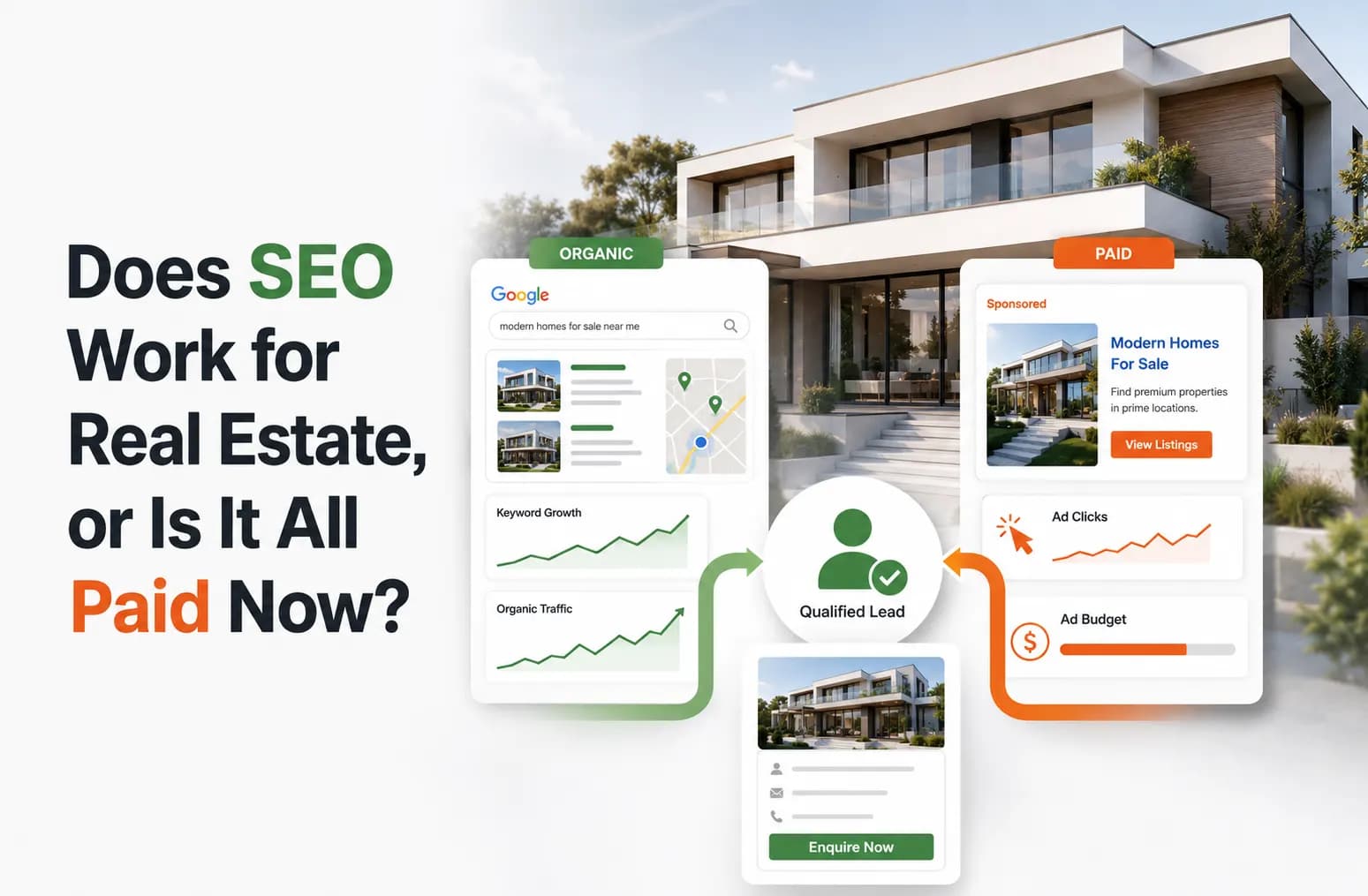
Yes, SEO still works for real estate in 2026, and in most markets it produces a lower cost per closed deal than paid ads. Google Ads in real estate now runs around $102 per lead and cost per click is rising 27 percent year over year, while organic search leads close at roughly 14.6 percent versus 1.7 percent for outbound. The right framing is not SEO versus paid, it is a portfolio: paid for speed and launches, SEO and content for durability and compounding cost efficiency. Agencies that run both typically drop their blended cost per acquired client 20 to 40 percent inside 18 months.
What is SEO for real estate and how does it work in 2026?
SEO for real estate is the ongoing work of ranking a website in Google, Bing, and AI search (ChatGPT, Perplexity, Google AI Overviews) for the queries buyers, sellers, and investors actually run. In practice that means city and neighbourhood pages, room-type and price-band pages, community and lifestyle content, and structured content that AI engines can lift and cite.
The mechanics have shifted since 2020. Buyers no longer search only in Google; they research in Instagram, TikTok, ChatGPT, and Perplexity before they contact any agent. Modern SEO for real estate covers all four surfaces: traditional organic (Google), local map pack (Google Business Profile), AEO (AI-generated answers), and social search (Instagram, TikTok discover pages). An operator visible on one and invisible on the others captures a fraction of the intent.
The compounding characteristic is what makes SEO different from paid. A single well-optimised neighbourhood page keeps producing leads for two to five years after publication. A paid ad stops producing the moment the budget stops.
For more, see our SEO and AEO service page and Real estate PropTech SEO.
Why does paid feel like it is winning right now?
Paid feels like it is winning because paid produces leads today and SEO produces them in six months. If an operator opens a new office in September and needs enquiries by October, paid is the only channel that can deliver at that timeline. The visibility of paid results (a Google Ads dashboard shows spend and leads in real time) also makes it feel more real than the slower, harder-to-attribute growth of organic search.
The second reason is that portals and paid platforms have spent the last five years positioning themselves as the default. Zillow, Realtor.com, Rightmove, and 99acres have massive budgets and a commercial incentive to convince agents that portal leads are the pipeline. Google itself makes more money the more agents bid on real estate keywords, which is why the top of every real estate SERP is now a stack of ads.
But feel and math are different. When agencies actually attribute closed deals back to first-touch channel, they routinely find that organic search and referrals produce the majority of closed pipeline while paid produces the majority of the volume. The gap between what feels like it is working and what is actually closing deals is where budget gets wasted.
How do SEO and paid ads compare on cost per closed deal?
The honest comparison is not cost per lead, it is cost per acquired client (the metric that actually ties to revenue).
Channel | Approx. cost per lead | Close rate | Cost per acquired client |
|---|---|---|---|
Google Ads (high-intent search) | ~$102 | 3 to 8% | $1,275 to $3,400 |
Meta paid social (Tier 1 markets) | $35 to $65 | 1 to 3% | $1,200 to $6,500 |
Organic search / SEO | Lowest over time | 10 to 15% | Materially lower after month 9 |
Referrals and past clients | Near-zero | 20 to 40% | Near-zero |
Portals (Zillow, Realtor.com, etc.) | Variable + commission | 5 to 10% | Highest once commission is included |
Two patterns show up in this data. First, the cheapest lead is not the cheapest client. A Meta lead at $52 that closes at 2 percent is more expensive per client than a Google lead at $102 that closes at 6 percent. Second, organic search and referrals are structurally cheaper per client than any paid channel once the SEO programme matures, because there is no per-lead media cost, only the fixed cost of the content and technical work.
This is why every serious agency runs both channels and measures the blended cost per acquired client quarter over quarter, not the cheapest headline CPL.
When does SEO make more sense than paid for a real estate operator?
SEO is the right lead channel when:
You want durability, not just volume. Every ranked page keeps producing leads for two to five years. Every paid ad stops the moment the card gets declined.
You operate in a specific geography. Neighbourhood, city, and school-district pages are lower competition than paid keywords and hold rankings for years.
You sell education-heavy products. First-time buyers, coliving, investment, luxury, relocation, and off-plan all involve long research windows where buyers Google for weeks before contacting anyone. SEO captures that window; paid does not.
You are trying to reduce portal dependency. Portals sit on top of Google. Ranking directly means fewer commission-taking middlemen between the buyer and the operator.
You need to compound blended cost per lead down. The only channel that gets cheaper the longer it runs is organic. Paid gets more expensive.
For a 90-day roadmap on how the SEO layer fits inside a full growth programme, see our guide on how digital marketing boosts lead generation for real estate agencies.
When does paid make more sense than SEO?
Paid is the right lead channel when:
You need enquiries this week. New market launch, new office opening, a specific listing that needs to move, a fundraising or M&A moment where the pipeline needs to look strong. Paid delivers inside 48 hours; SEO does not.
You are competing in a market where you have no organic foothold. If ranking will take 12 months but leads are needed now, paid is the bridge.
You are testing a new offer or niche. Paid lets you measure demand for a new price band, neighbourhood, or vertical inside a month, before committing to a six-month content investment.
You have a very short buyer window. Rentals in a hot market, short-let bookings, and time-sensitive off-plan launches all have decision cycles measured in days, where paid retargeting outperforms slower organic.
You have retargeting audiences to work. Paid retargeting against website visitors converts three to five times higher than any cold audience. This works only when there is already traffic to retarget, which is where SEO and paid feed each other.
What is the right mix of SEO and paid for a real estate operator?
The right mix is a portfolio, not a percentage locked in stone. For most independent agencies and boutique brokerages, the trajectory looks like this:
Months 1 to 6. Heavier on paid, roughly 70 percent of budget on paid search and paid social, 30 percent on SEO foundation (technical fixes, keyword mapping, first content, Google Business Profile per property or office).
Months 6 to 12. Rebalancing, around 50/50. SEO starts producing enquiries and the blended cost per lead drops. Paid stays active but no longer carries the whole pipeline.
Months 12 to 18. Weighted to SEO, around 60 percent SEO and content, 40 percent paid. Organic leads are cheaper and close better; paid becomes the top-up layer, plus retargeting.
Beyond 18 months. Roughly 40 percent SEO and content, 30 percent paid, 20 percent referrals and nurture, 10 percent portals. Not because any single channel is best but because the portfolio is resilient to platform, pricing, and algorithm shocks.
The single biggest lift most agencies get is not shifting the mix, it is fixing lead leakage. If enquiries from any channel are followed up in hours instead of minutes, the whole engine underperforms regardless of how the budget is split. See our post on how to reduce lead leakage in real estate.
How long does SEO take to work for a real estate website?
Technical fixes ship inside the first 6 weeks. First-page rankings on longer-tail city and neighbourhood queries typically land inside 3 to 6 months. Head-term rankings on competitive metros take 9 to 12 months of consistent content and link building. AEO citations from ChatGPT, Perplexity, and Google AI Overviews typically start showing inside 4 to 6 months of structured content publishing.
This is why the mix rebalances over time. Nothing about SEO is instant, but nothing about paid is durable. Running both simultaneously is how the operator gets both properties.
What kills SEO for real estate agencies (and how to fix it)?
Six things kill real estate SEO programmes more often than anything else.
Publishing without a keyword strategy. Random blog posts on generic topics rank for nothing. Fix: map every page to a specific keyword and search intent before writing.
Templated city and neighbourhood pages. Duplicate boilerplate across cities gets penalised. Fix: original content, local photography, real market data, local schema per page.
Ignoring Google Business Profile. Every office and every property is a local SEO opportunity. Fix: fully populated GBP per location with reviews, posts, and Q&A managed weekly.
No AEO structure. Content written for humans only will not get cited by AI search. Fix: quick-answer blocks, FAQ schema, cited statistics, and structured content on every long-form page.
Slow site and broken technical foundation. Core Web Vitals in the red kills rankings regardless of content quality. Fix: technical audit, indexation clean-up, mobile experience tuning.
Quitting at month 4. SEO compounds after month 6. Quitting at month 4 is the single most expensive mistake an operator can make. Fix: 12-month commitment or do not start.
The agencies that avoid these six mistakes see organic search go from under 10 percent of their pipeline to 40 percent or more inside 18 months.
SEO works for real estate in 2026, and in most markets it beats paid on cost per closed deal. But the right answer is not SEO versus paid, it is running both as a portfolio: paid for speed and launches, SEO for durability and compounding cost efficiency, referrals for repeat business, and AEO for the AI-search citations that are becoming their own discovery channel. The operator who commits to 12 months of both, plugs the lead leakage between them, and measures on closed deals rather than clicks is the one whose blended cost per acquired client falls year over year while competitors keep paying premium prices for every lead.
Ready to see what SEO can do for your real estate business?
Book a free SEO audit call with the Noseberry Digitals team. We will audit your current search visibility, benchmark against your local competitors, and hand you a 12-month roadmap covering technical, content, local, and AEO. No commitment, no pitch, just the report.
- SEO closes better than paid. Inbound SEO leads close at 14.6 percent versus 1.7 percent for outbound and cold paid channels, according to HubSpot benchmarks.
- Paid is getting more expensive fast. Real estate had the highest year-over-year rise in Google Ads cost per click of any industry at 27 percent, per WordStream, and now averages around $102 per lead.
- SEO takes 6 to 12 months to compound. Once it does, it keeps producing leads for years without further ad spend, which is why blended cost per lead falls the longer both channels run together.
- Buyers start on Google and mobile. NAR reports 52 percent of home buyers found their home online and 76 percent of home searches begin on a mobile device, which means the operator with strong search visibility captures buyers before any agent conversation begins.
- The winning mix is a portfolio. Paid for launches and immediate volume, SEO for durability, content for AI search citation, referrals for repeat business. Not one channel, five to seven working together.
Why trust Noseberry
Our content is written by practicing real-estate and PropTech professionals, fact-checked by a dedicated editorial team, and reviewed against the latest industry data before publication.
- 10+ years of industry expertise
- All facts independently verified
- No sponsored rankings in guides
- Updated when the industry changes
Frequently Asked Question
Does SEO actually work for real estate in 2026?
Inbound SEO leads close at 14.6 percent versus 1.7 percent for outbound, per HubSpot. Buyers begin their journey online (52 percent found their home online, per NAR), and the operator visible in Google, local map packs, and AI search captures that intent before any agent conversation begins.
Which is cheaper, SEO or paid ads for real estate?
On cost per lead, SEO is cheaper once mature (from month 9 onwards). On cost per acquired client, SEO is materially cheaper because organic leads close at 10 to 15 percent versus 3 to 8 percent for paid. Paid is faster; SEO is cheaper long-term.
How long does real estate SEO take to show results?
Technical fixes land in weeks 1 to 6. First-page rankings on longer-tail queries land in 3 to 6 months. Competitive metro head terms take 9 to 12 months. AI search citations start in month 4 to 6 with structured content.
Can a small brokerage compete with big portals on SEO?
Yes, on the right queries. Portals dominate broad terms (apartments in New York). Boutique operators can outrank portals on neighbourhood, room-type, stay-length, and community-intent queries where the portal's generic listing pages are weaker than a well-written local page.
Should we drop paid ads if we invest in SEO?
No. Paid buys speed, SEO buys durability. Run both. Rebalance the split over 18 months as SEO matures. Cutting paid entirely leaves the pipeline exposed while SEO is still compounding.
Related insights
 Real Estate
Why Noseberry Digitals is one of the best real estate mobile app development company in USA
This blog explains why Noseberry Digitals stands out as a real estate mobile app development company, built around a focused history of property and proptech clients rather than general app development. It walks through the seven-phase development process, the native versus cross-platform decision, and the app store compliance work behind a 14-of-16 first-try approval rate. It shares measurable client results, including faster navigation, lower bounce rates, and occupancy gains from real coliving, brokerage, and marketplace projects. It also compares Noseberry against typical generalist agencies on cost, ownership, and post-launch support. The article closes with a 10-question FAQ covering cost, timeline, and technology choices for anyone evaluating a real estate app development partner.
September 8, 2026 Real Estate
Top 5 Software Development Company for Real Estate in USA: Full Comparison Guide
This blog ranks and compares the top five software development companies for real estate in the USA, starting with Noseberry Digitals and covering Ascendix Technologies, TechAhead, Chetu, and Itransition. It walks through what actually separates a real estate specialist from a general software vendor, including source code ownership, industry focus, and post-launch support. The piece includes a side-by-side comparison table covering headquarters, experience, and specialty for each company. It also breaks down realistic pricing ranges, engagement models, and red flags to watch for before signing a contract. The article closes with a 10-question FAQ section covering selection criteria, costs, and timelines.
September 7, 2026 Real Estate
PropTech Software Development: How Noseberry Digitals Builds Smarter Real Estate Solutions in USA
This blog explains what proptech software development actually involves and why real estate businesses need purpose-built platforms instead of generic SaaS tools. It covers what to look for in a proptech software development company, from code ownership to pricing structure to documented build timelines. It walks through how Noseberry Digitals runs its six-phase build process, the types of platforms it builds most often, and the compliance awareness baked into that work. The piece includes real case study results, a comparison of in-house, freelance, and agency development models, and common mistakes real estate companies make when choosing a partner. It closes with a direct answer to why choose Noseberry Digitals as a proptech software development agency, backed by verifiable stats rather than marketing claims.
September 7, 2026
Ready to book a 30-minute strategy call?
We'll map the right digital moves for your real estate business, no pitch deck, no commitment.