

Honey Saxena
Digital Marketing Expert
Are Google Ads Worth It for Real Estate in 2026?
Published July 21, 2026|10 min read

Yes, Google Ads can be worth it for real estate when campaigns target high-intent searches, use dedicated landing pages and track leads through to site visits and completed transactions. In 2026, a good real estate cost per lead is not one universal number. It is any CPL that remains below your maximum allowable lead cost and produces profitable customers.
Public 2026 search advertising data indicate an average real estate Google Ads cost per lead of approximately $102.51, with an average conversion rate of 3.70%. However, costs vary considerably by property type, location, competition, lead definition, and sales performance.
What Makes Google Ads Worth It for Real Estate?
Google Ads can place a property business in front of people at the exact moment they are searching for a home, agent, development, rental property, or investment opportunity.
A person searching for “3 BHK apartments in Noida,” “estate agents near me,” or “Dubai property investment” has already expressed a clear need. This makes search traffic different from social media traffic, where an advertiser may need to create demand before generating an enquiry.
Google Ads can be valuable for:
Residential property developers
Real estate brokerages
Independent agents
Property management companies
Co-living and build-to-rent operators
Commercial real estate firms
Property investment businesses
PropTech platforms
The main advantage is control. Advertisers can choose their locations, keywords, budgets, schedules, audience signals and landing pages. They can also connect campaigns with CRM data to identify which keywords produce qualified leads, site visits and sales.
Google Ads may not be profitable when campaigns send traffic to a generic homepage, target broad locations, attract irrelevant enquiries or measure every form submission as an equally valuable lead.
For an end-to-end acquisition strategy, explore Noseberry Digitals’ real estate digital marketing services.
What Is a Good Cost per Lead for Real Estate Google Ads?
A good real estate Google Ads CPL is one that allows the business to acquire a customer profitably. The correct target depends on gross profit per completed transaction, lead-to-sale conversion rate, and the percentage of profit the business is willing to invest in customer acquisition.
For example, imagine that a brokerage earns $6,000 in gross profit from an average completed transaction. If 2% of its qualified leads become clients, each qualified lead has an expected gross-profit value of:
$6,000 × 2% = $120
If the brokerage is prepared to spend 30% of that expected value on advertising, its target CPL would be:
$120 × 30% = $36
In this example:
Break-even CPL: $120
Target CPL: $36
CPL below $36: Potentially strong
CPL between $36 and $120: Requires further profitability analysis
CPL above $120: Unprofitable before considering overhead and sales costs
This calculation is more useful than comparing the account with a broad industry average.
What Are the 2026 Google Ads Benchmarks for Real Estate?
According to LocaliQ’s 2026 search advertising benchmark data, the average real estate search campaign recorded:
Metric | 2026 benchmark |
|---|---|
Click-through rate | 7.61% |
Cost per click | $3.22 |
Conversion rate | 3.70% |
Cost per lead | $102.51 |
The real estate conversion rate increased to 3.70%, but the industry continued to have one of the higher costs per lead. The cross-industry average CPL was $66.69, compared with $102.51 for real estate. See the 2026 benchmark analysis.
These statistics provide a useful reference, but they should not be treated as fixed targets. A $100 lead might be highly profitable for a luxury property developer but unsustainable for a low-value rental service.
Noseberry Digitals’ existing Google Ads for real estate guide also provides geography and asset-class benchmarks for developers, brokerages, coliving operators and PropTech businesses.
Why Does Real Estate Cost per Lead Vary So Much?
Real estate CPL can vary from one campaign to another because the value, competition, and buying journey are different in every market.
Location
Keywords targeting London, New York, Dubai, Singapore, Mumbai or other competitive markets generally cost more than keywords for smaller locations.
Targeting an entire country can also attract users who are outside the project’s practical sales area. Campaigns should normally be divided by city, neighbourhood or service area.
Property type
Luxury apartments, commercial developments and investment properties can generate higher CPCs and CPLs than affordable housing or rental enquiries. However, they may also produce more revenue per completed deal.
Search intent
A keyword such as “what is property investment” shows research intent. A keyword such as “apartments for sale in Dubai Marina” shows commercial intent.
Bottom-of-funnel keywords generally cost more, but they are more likely to produce qualified enquiries.
Lead definition
A form submission is not automatically a qualified lead. A campaign might report a low CPL while generating people with the wrong budget, location, property preference or purchase timeline.
Real estate businesses should separately measure:
Raw enquiry CPL
Marketing-qualified lead CPL
Sales-qualified lead CPL
Cost per booked appointment
Cost per site visit
Customer acquisition cost
Landing-page quality
A dedicated landing page can match the visitor’s search, explain the offer and provide one clear conversion action. A generic homepage often introduces unnecessary navigation and unrelated information.
Noseberry Digitals’ real estate website development service covers dedicated landing pages, conversion tracking and CRM-ready enquiry flows.
Sales follow-up
An advertiser can generate excellent enquiries and still lose money if its sales team responds slowly or fails to nurture prospects.
Research published by Harvard Business Review found that companies attempting to contact potential customers within an hour were nearly seven times more likely to qualify the lead than businesses that waited longer than an hour. Read the lead-response research.
How Does the Real Estate Google Ads CPL Calculator Work?
The calculator estimates:
Current cost per lead
Break-even cost per lead
Recommended target CPL
Estimated monthly lead volume
Estimated sales
Estimated gross profit
Expected advertising return
Whether the current CPL is sustainable
Calculator input fields
Input | Description |
|---|---|
Currency | USD, GBP, EUR, AED or INR |
Monthly Google Ads budget | Total monthly media spend |
Current monthly leads | Leads attributed to Google Ads |
Qualified lead rate | Percentage of raw leads that meet your criteria |
Lead-to-sale rate | Percentage of qualified leads that become customers |
Gross profit per sale | Revenue minus direct transaction costs |
Target ad cost percentage | Percentage of gross profit available for advertising |
Calculator outputs
Output | Formula |
|---|---|
Current raw CPL | Ad spend ÷ total leads |
Qualified CPL | Ad spend ÷ qualified leads |
Break-even qualified CPL | Gross profit per sale × qualified-lead-to-sale rate |
Target qualified CPL | Break-even CPL × target ad cost percentage |
Estimated qualified leads | Total leads × qualified lead rate |
Estimated sales | Qualified leads × lead-to-sale rate |
Estimated gross profit | Sales × gross profit per sale |
Gross profit ROAS | Estimated gross profit ÷ ad spend |
How Should the Calculator Interpret the Result?
Use three performance levels.
Profitable
Show this result when:
Current qualified CPL ≤ Target qualified CPL
Suggested message:
Your current qualified CPL is within the recommended range. Based on the numbers entered, the campaign has room to remain profitable after advertising costs.
Review required
Show this result when:
Current qualified CPL > Target CPL but < Break-even CPL
Suggested message:
Your CPL is above your preferred target but remains below the estimated break-even point. Review lead quality, landing-page conversion and sales performance before increasing the budget.
Unprofitable
Show this result when:
Current qualified CPL ≥ Break-even CPL
Suggested message:
Your current qualified CPL is at or above the estimated break-even point. The campaign may lose money unless repeat revenue or additional customer value has not been included.
Include this disclaimer beneath the result:
This calculator provides an estimate based on the information entered. Actual campaign performance may vary due to attribution, operating costs, cancellations, delayed sales and differences in lead quality.
How Can a Real Estate Business Calculate Its Maximum CPL?
Use the following formula:
Maximum break-even CPL = Gross profit per sale × Lead-to-sale rate
If the business wants advertising costs to equal only a specific percentage of gross profit:
Target CPL = Gross profit per sale × Lead-to-sale rate × Target ad cost percentage
Example calculation
A residential developer enters:
Gross profit per completed sale: $25,000
Qualified lead-to-sale rate: 1.5%
Target ad cost percentage: 25%
Monthly ad budget: $10,000
Monthly raw leads: 150
Qualified lead rate: 40%
The calculation is:
Current raw CPL: $10,000 ÷ 150 = $66.67
Qualified leads: 150 × 40% = 60
Current qualified CPL: $10,000 ÷ 60 = $166.67
Break-even qualified CPL: $25,000 × 1.5% = $375
Target qualified CPL: $375 × 25% = $93.75
Although the raw CPL appears strong at $66.67, the qualified CPL of $166.67 is above the preferred target of $93.75. The campaign remains below break-even, but it needs better lead qualification, conversion or campaign efficiency.
This example demonstrates why businesses should not optimise campaigns using raw CPL alone.
When Are Google Ads Most Effective for Real Estate?
Google Ads are especially effective when a real estate business needs to capture existing demand.
Common high-value situations include:
Launching a new residential development
Generating buyer or seller appointments
Promoting available rental inventory
Entering a new city or neighbourhood
Filling vacant coliving or build-to-rent units
Finding investors for a defined opportunity
Generating enquiries for a limited-time offer
Supporting an existing organic search strategy
Search campaigns are often the best starting point because they capture people already looking for a relevant property or service.
Performance Max, YouTube and Display can support discovery and remarketing, but they should have separate goals and conversion reporting. Display impressions should not be evaluated using the same CPL expectations as high-intent Search campaigns.
When Are Google Ads Not Worth It for Real Estate?
Google Ads may not be worth the investment when the business cannot answer basic questions about its economics or sales process.
Warning signs include:
No clear gross profit per transaction
No conversion tracking
No dedicated landing page
No CRM source attribution
No system for qualifying leads
Slow sales follow-up
Broad targeting across irrelevant locations
A monthly budget too small to generate meaningful data
Optimisation based only on clicks or raw enquiries
Campaigns stopped before the sales cycle can be evaluated
If a company receives only a few clicks per month, the advertising platform may not collect enough conversion data for reliable optimisation. In this situation, focusing on a smaller area and a narrower set of high-intent keywords is usually more effective.
How Can You Reduce Google Ads CPL for Real Estate?
Target high-intent keywords
Focus on searches that indicate a clear property requirement, location or transaction goal.
Examples include:
“3 bedroom apartments for sale in [location]”
“commercial property agent in [city]”
“new build homes near [location]”
“coliving rooms in [city]”
“sell my house in [location]”
Build one landing page per intent group
The page should closely match the keyword and advertisement. Include the location, property type, price guidance, essential features, trust signals, and one primary CTA.
Add negative keywords
Exclude searches related to jobs, salaries, free accommodation, definitions, training, complaints and locations outside the sales area.
Improve qualification
Ask only the questions required to determine whether a prospect is suitable. These might include budget, preferred location, property type, purchase timeline and financing status.
Avoid making the form so long that serious buyers abandon it.
Connect Google Ads with the CRM
Import qualified leads, appointments and completed transactions back into Google Ads. This helps automated bidding distinguish between low-value form fills and outcomes that generate revenue.
Noseberry Digitals’ real estate CRM implementation services help connect campaign sources, lead stages and revenue attribution.
Measure by keyword and outcome
A keyword producing ten cheap enquiries and no appointments is less valuable than a keyword producing three expensive enquiries and one completed sale.
Campaign reporting should include:
Spend
Raw leads
Qualified leads
Appointments
Site visits
Opportunities
Completed transactions
Gross profit
Customer acquisition cost
How Do Google Ads and SEO Work Together?
Google Ads produces visibility while the campaign is funded. SEO can generate organic traffic over a longer period without paying for each click.
Using both channels helps real estate businesses:
Capture immediate demand through advertisements
Build long-term organic visibility
Identify high-converting search terms
Retarget visitors who discovered the brand organically
Occupy both paid and organic positions
Reduce blended acquisition cost over time
Read Noseberry Digitals’ comparison of SEO vs Google Ads for real estate and its 2026 real estate performance marketing playbook.
How Should You Decide Whether Google Ads Are Worth It?
Use this five-question test:
Do people actively search for your property type or service?
Can you calculate your gross profit per completed transaction?
Can you track leads from Google Ads through to a sale?
Can your team consistently respond to and qualify leads?
Is your maximum allowable CPL higher than the expected qualified CPL?
If the answer to all five questions is yes, Google Ads has a strong chance of becoming a profitable acquisition channel.
If the answer to questions 2, 3, or 4 is no, fix the measurement and sales infrastructure before scaling the advertising budget.
Want help improving campaign quality, landing-page conversion, and CRM attribution? Book a free strategy call with Noseberry Digitals.
Use the Free tool for real estate
- The 2026 average Google Ads CPL for real estate is approximately $102.51.
- A good CPL remains profitable after accounting for lead qualification and sales conversion.
- The correct CPL target should be calculated from gross profit per transaction and lead-to-sale conversion rate.
- Search campaigns are usually best for high-intent property enquiries.
- Qualified lead cost, appointment cost, and customer acquisition cost matter more than raw form-fill CPL.
Why trust Noseberry
Our content is written by practicing real-estate and PropTech professionals, fact-checked by a dedicated editorial team, and reviewed against the latest industry data before publication.
- 10+ years of industry expertise
- All facts independently verified
- No sponsored rankings in guides
- Updated when the industry changes
Frequently Asked Question
Are Google Ads worth it for real estate agents?
Yes. Google Ads can be profitable for real estate agents when they target high-intent local searches, use dedicated landing pages and track leads through to appointments and completed transactions. Profitability should be evaluated using qualified CPL and customer acquisition cost rather than the number of form submissions.
What is the average Google Ads CPL for real estate in 2026?
The 2026 real estate search advertising benchmark is approximately $102.51 per lead. Actual CPL can be considerably lower or higher depending on geography, property value, competition, campaign structure, and what the advertiser counts as a lead.
What is considered a good cost per lead in real estate?
A good CPL is lower than the maximum amount a business can afford to spend while remaining profitable. Calculate it by multiplying gross profit per completed transaction by the lead-to-sale conversion rate and target advertising cost percentage.
How much should a real estate agent spend on Google Ads?
The budget should be large enough to generate sufficient clicks and conversions within the selected market. Start with the expected CPC, the target number of monthly leads, and the maximum affordable CPL. Avoid selecting an arbitrary budget without considering conversion rates and transaction economics.
How long does it take for real estate Google Ads to work?
Clicks and enquiries can begin shortly after a campaign launches, but reliable profitability data may take several weeks or a full sales cycle. Property transactions often involve lengthy decision periods, so early CPL should not be treated as the final ROI.
Should real estate businesses use Google Ads or Meta Ads?
Google Ads is generally stronger for capturing existing search intent. Meta Ads is useful for generating awareness, promoting visual property content, and retargeting previous visitors. Many real estate businesses use both platforms for different stages of the customer journey.
Why is my real estate Google Ads CPL so high?
Common causes include broad targeting, irrelevant keywords, weak negative keyword lists, poor landing-page relevance, low conversion rates, excessive form friction and inaccurate conversion tracking. A high CPL can also be normal in a competitive luxury or commercial property market.
Should I optimise for leads or qualified leads?
Optimise toward qualified leads whenever there is enough conversion data. Raw lead optimisation can encourage advertising platforms to find users who complete forms easily, even when they have little chance of becoming customers.
Related insights
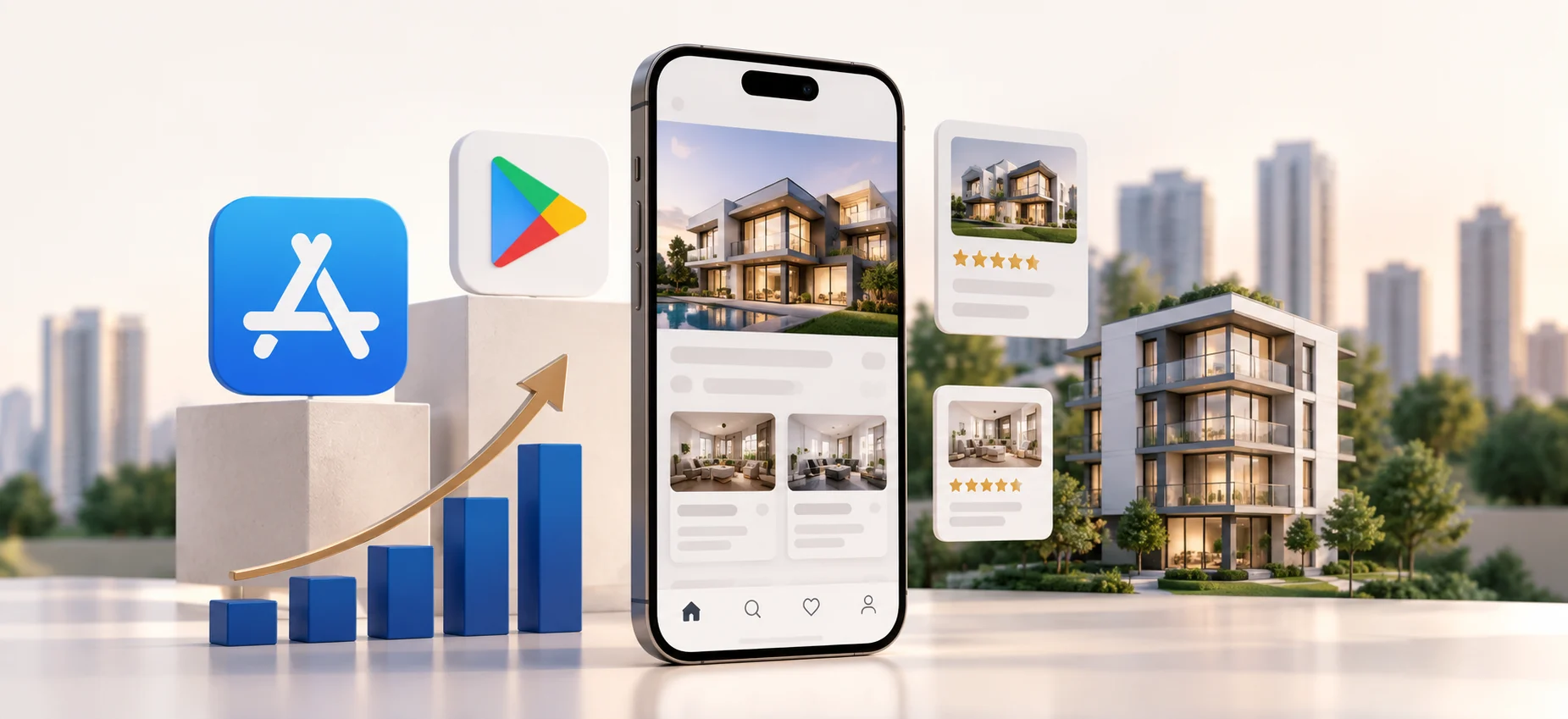 Real Estate
App Store Optimization (ASO) for Real Estate and PropTech Apps
App Store Optimization for real estate and proptech apps isn't a launch-week checklist. It's an ongoing habit. It's built on precise keyword mapping, screenshots that show real use cases, a review timing plan, and metadata that stays honest as the app grows. Teams that treat their listing as a living asset, tested every quarter, tend to out-rank competitors with bigger budgets and bigger dev teams.
September 4, 2026 Real Estate
Influencer and Creator Marketing for Real Estate Brands: Beyond the Listing Video
This blog breaks down influencer marketing and creator marketing for real estate brands as two distinct strategies, not one interchangeable tactic. It explains the difference between paying for an influencer's existing audience versus paying a creator for original content your brand can reuse. It covers six content formats that outperform a basic listing walkthrough, from neighborhood guides to buyer testimonial clips. It compares running these partnerships in-house against hiring a specialized agency, with real cost and speed benchmarks. It closes with FTC disclosure and Fair Housing compliance rules every real estate brand needs before its next sponsored post.
September 2, 2026 Real Estate
Real Estate Digital Agency in USA: How Noseberry Digitals Helps Developers & PropTech Companies Grow
This blog explains what makes Noseberry Digitals a real estate digital agency in USA built for developers and proptech companies. It covers why generalist agencies struggle with real estate-specific needs like MLS integrations and multi-market brand consistency. It walks through the agency's full-stack services, from branding and websites to CRM, AI, and a 60-day proptech MVP program. It highlights named, documented case studies with real client results, something the piece notes is rare among proptech marketing agencies. It closes with a practical checklist for choosing a real estate digital agency and clears up whether Noseberry Digitals is itself a proptech company.
August 27, 2026
Ready to book a 30-minute strategy call?
We'll map the right digital moves for your real estate business, no pitch deck, no commitment.