

Sandeep
Product Designer
How can agencies balance agents' personal brands with the office brand?
Published July 23, 2026|12 min read
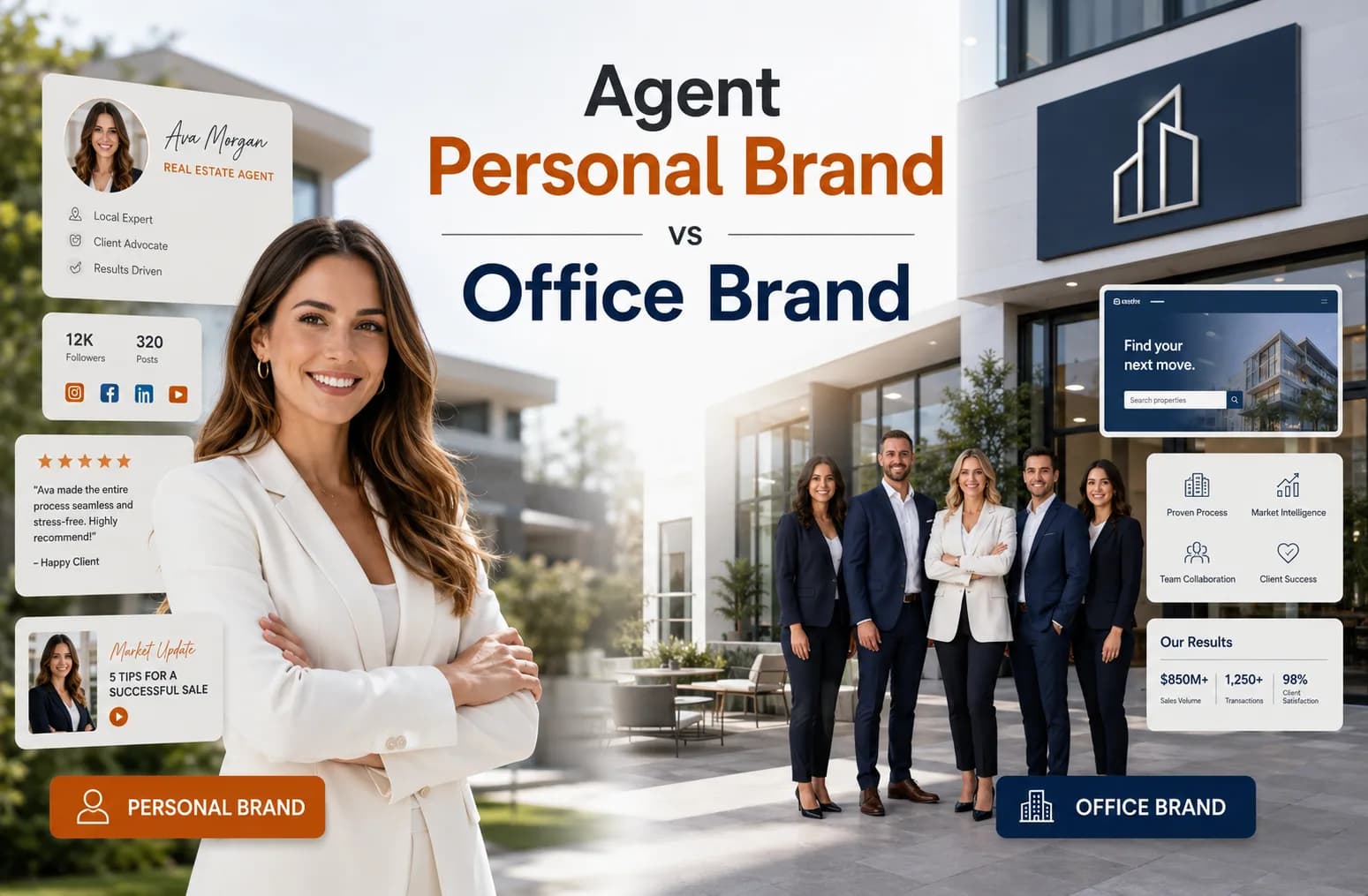
Agencies balance agent personal brands with the office brand by giving agents room to build their own visible presence inside a set of clear brand guardrails, while the agency owns the client relationships, the CRM data, and the referral engine. The frame that works is not agent-first or agency-first. It is agent-branded execution running inside agency-controlled architecture. Top-producing agents earn 60 to 80 percent of their business from referrals, and agencies that suppress personal branding lose those agents to competitors who do not. Agencies that let personal branding run without guardrails lose the client relationship the moment the agent leaves. The two things are not in opposition once the agency defines what each side owns.
Why does the tension between personal brand and office brand exist?
The tension is structural, not political. Real estate is one of the few businesses where the individual salesperson is the actual product a client evaluates, but the transaction and the compliance sit inside a licensed agency. Every buyer choosing a listing agent and every seller choosing who to work with is picking a person; the office brand helps at the margins but rarely decides the appointment.
At the same time, the agency carries the licence, the E and O insurance, the marketing budget, the CRM, the compliance stack, and the reputational risk if an agent posts something off-brand or off-message. The office has legitimate reasons to want brand consistency. The agent has legitimate reasons to build a personal presence that generates their own leads. Neither party is wrong; they are optimising for different things.
The mistake agencies make is treating this as a control problem. It is not. It is a design problem. The right answer is a brand architecture that gives each side what it needs and holds the line where the interests genuinely conflict. Agencies that get this right retain top producers and grow. Agencies that lean too far in either direction lose.
For the underlying framework, see our branding service page and the social media marketing service.
What happens when the office brand is too strong?
When the agency clamps down on personal branding, four things happen predictably.
Top producers leave. The agents who could build meaningful audiences elsewhere do exactly that, taking their referral network with them. In markets where turnover data is tracked, agencies that discourage personal branding run at two to three times the industry-average agent turnover.
Content dies. When every social post has to be approved by a marketing coordinator and posted from a brokerage account, the volume collapses. Agents stop posting because the friction outweighs the reward. Reach drops with it.
Referrals stagnate. NAR reports top-producing agents get 60 to 80 percent of business from referrals and repeat clients. Referrals are a personal relationship channel. When agents cannot maintain a visible personal presence, past clients stop remembering them and the referrals dry up.
The agency looks like every other agency. Office-only branding across a competitive market produces indistinguishable Instagram accounts, indistinguishable Facebook pages, and indistinguishable listing photos. In a business where trust is picked from a shortlist, being indistinguishable is a strategy for losing.
What happens when personal brands are too strong?
The opposite failure mode is just as damaging. When agents build their personal brands with no agency guardrails, five things go wrong.
The client experience becomes inconsistent. Each agent runs different visual styles, different messaging, different service promises. Buyers who hire the agency get materially different experiences depending on which agent picks up the phone.
The agency loses attribution and CRM control. Agents keep leads in personal WhatsApp inboxes, personal spreadsheets, and personal Instagram DMs. When the agent goes on holiday, the leads go quiet. When the agent leaves, the leads leave with them.
Referrals bypass the agency. Past clients refer to the agent by name, not by office. The agent moves brokerages and the entire referral pipeline moves too. The agency spent years subsidising the growth of a brand it never owned.
Brand risk multiplies. Off-brand posts, off-message pricing claims, mixed compliance messaging, and photography that would never pass agency review all go live daily. The agency carries the reputational and regulatory risk without seeing the content.
The agency cannot rebuild without them. Because the client relationships live at the personal level, the agency has no way to nurture past clients when the agent walks. Every departure resets the past-client base.
How do winning agencies structure the split?
The framework that works is straightforward once written down. It draws a hard line between what the agent owns and what the agency owns, and it gives each side the freedom to run inside their zone.
What the agent owns. The face on camera. The written voice in captions and emails. The DMs. The personal Instagram, TikTok, YouTube, and LinkedIn accounts. The relationships with clients, past clients, and referral partners.
What the agency owns. The brand system (colours, typography, logo, photography style, visual guardrails). The CRM and all data inside it. The marketing budget and how it is allocated across the team. The website, the landing pages, and the domain. Compliance and legal review of anything that touches property claims or pricing. The referral engine that runs across the past-client base at agency level.
What both share. Content produced under the agency brand system but voiced by individual agents. Case studies that feature the agent's face and the agency's process. Listings marketed through agency channels with the agent's personal social layered on. Retargeting campaigns that surface both.
The agencies that draw this line clearly retain agents at industry-leading rates and still hold the client relationship if an agent moves on. The agencies that leave it fuzzy end up with either mass agent departures or mass client departures. Both are avoidable.
For more on this operating model, see our post on how social media marketing helps real estate agents.
Who owns the client relationship, the agent or the agency?
Legally, contractually, and operationally, the client relationship sits with the agency. The listing agreement, the buyer representation agreement, and the fiduciary duty all attach to the agency. The commission cheque flows through the agency. The CRM record lives on agency infrastructure. All of this needs to be true, documented, and enforced.
Practically and emotionally, the client relationship also sits with the individual agent. The client picked the agent. The client texted the agent. The client remembers the agent's name and forgets the agency's the moment they close.
Both are true, and the framework has to hold both. The way this plays out in a well-run agency:
The agent runs the relationship. Every call, every showing, every email, every negotiation runs through the agent, with the agent's face and voice on it.
The agency captures the data. Every touch is logged in the shared CRM. Every enquiry, every note, every follow-up. Agents cannot run their own CRM in parallel.
The agency owns the past-client base. Post-close, the client sits inside the agency's nurture programme (monthly market updates, quarterly newsletters, home-anniversary follow-ups). The agent gets attributed to the client inside the CRM and shows up on every touchpoint, but the operational nurture runs at agency level.
The agent gets personal touchpoints too. Birthday notes, hand-written thank-yous, personal video updates. These live alongside the agency programme, not in place of it.
This is the design that lets the agency retain the client if the agent leaves and lets the agent keep the personal relationship while they are there. Neither side is asked to give up their claim.
What do the brand guardrails look like in practice?
Guardrails are not a personality suppressant. They are a spec. Done well, they make the agent's personal content look better than it would on its own, because agents get a professional brand system without having to hire a designer.
A workable set of guardrails covers eight things:
Visual identity. Agency logo, colour palette, typography, and photography style. Any post that shows an agency listing, an agency office, or agency-branded materials sits inside this. Personal content (agent-only clips, personal storytelling, personal-life content) can flex.
Templates for common posts. Just-listed, just-sold, price-drop, open-house, market-update. Agents get branded templates in Canva or Figma that carry the agency brand but leave room for the agent's photo, name, and personal caption.
Photography and video standards. Minimum quality bar (vertical 4K, natural or ring light, clean audio) applied to any content that includes an agency listing or the office. Personal-only content can be shot however the agent wants.
Claims and language rules. Any price claim, any exclusivity claim, any statistic about the market, any regulatory-adjacent language runs through a short compliance review. Personal opinion, personal storytelling, and general lifestyle content do not.
Bio and handle guidelines. Agent's own name in the handle, agency name and the agent's title in the bio, one link in bio pointing to a landing page on the agency domain (built for the agent).
Post-close protocols. Every closed client is added to the shared CRM within 48 hours. The agent can send personal thank-you touches; the agency runs the ongoing nurture.
Departure protocols. Signed at onboarding, not litigated at exit. What data and which relationships travel with an agent if they leave, and what stays with the agency. Written down while everybody is on the same side.
Support the agency provides in exchange. Filming days, editor time, paid social budget for personal content, landing pages, CRM access, and creative templates. This is the trade: guardrails in one direction, support in the other.
Agencies that put this on paper find agents accept the guardrails willingly, because the trade is a good one. Agencies that never write it down argue about it every quarter.
How does the agency support agent personal brands without losing control?
The agencies that get this right are aggressive about supporting personal brand execution while holding the underlying architecture. What that looks like:
Filming and editing. Quarterly filming days for every producing agent, edited into a batch of ninety-second reels, YouTube Shorts, and TikTok clips. Agents show up, film, and get finished content back inside two weeks. The agency covers the production cost.
Landing pages per agent. Every agent gets a landing page on the agency domain (yourname.agencyname.com or agencyname.com/team/yourname). The page is branded to the agency but centred on the agent, with their bio, listings, testimonials, and booking link. The agent runs traffic to this page rather than to their Instagram profile.
Paid social for personal content. The agency's ad budget boosts individual agents' best-performing organic posts. Agents whose personal content converts to leads get more budget; agents who post nothing get none. The incentive works.
CRM access with clear rules. Agents see their own pipeline, their own past clients, and their own nurture cadence inside the CRM. They cannot export the full client list; they cannot delete records; they cannot run a parallel database. The tradeoff is that they get top-tier tooling for free.
Broker-owner participation. In small and mid-size brokerages, the broker on camera alongside agents lifts everyone. Broker interviews, broker-agent conversations, broker market commentary. It reinforces that the agency and the individual are on the same side.
This is the layer where most agencies underinvest and lose top producers. When the agency provides real production value in exchange for the guardrails, agents rarely leave over branding. When the agency provides only rules, agents leave for any competitor offering more support.
For CRM setup at this level, see our CRM implementation service.
What happens when an agent leaves?
Departure is where every unclear brand agreement gets tested. Done right, it is a two-week transition. Done wrong, it is a lawsuit and a year of pipeline damage.
The clean version:
Signed at onboarding. The departure protocol is part of the agent's contract, not a conversation started when notice is given. It defines exactly what data, contacts, and IP travel with the agent (usually their personal content and personal contacts made independently of agency channels) and what stays (all CRM data, all agency-sourced leads, all past clients, all agency-branded content).
Client communication is joint. In the two weeks after notice, every open client is contacted by both the departing agent and an assigned replacement, ideally in the same message. The client chooses which they continue with. In practice, most stay with the agent for the current transaction and inherit the new agent for future business.
Past clients stay in the agency nurture. They also stay in the agent's personal contact list. The agent can continue personal touches (birthday notes, personal messages) but cannot mass-market to the past-client base or export the list.
Personal content stays with the agent. Their Instagram, TikTok, YouTube, and personal videos are theirs. Content produced by the agency (filmed on agency days, edited by agency editors, in agency templates) stays with the agency.
Referrals continue. Because the client relationship is genuinely shared, referrals from past clients continue for both sides, and in a healthy market both parties do fine after the split.
Agencies that draw this line clearly and enforce it consistently end up as reference brokerages: the ones agents want to join, because they know how they will be treated on the way out too. Agencies that fight every departure end up with reputations that make hiring the next producer harder.
The tension between agent personal brands and the office brand is real, but it is a design problem, not a control problem. The agencies that resolve it define exactly what each side owns, provide real production support to individual agents, run everything through a shared CRM they control, and put the departure protocol in writing before it is ever needed. The result is agents who stay longer, past clients who stay with the agency across agent transitions, and a brand system where the individuals and the institution reinforce each other rather than compete. That is the work Noseberry Digitals runs for real estate agencies: brand architecture, agent-level content systems, CRM implementation, and the operating model that turns two competing brand layers into one compounding growth engine.
Ready to design the brand architecture your agency actually needs?
Book a working session with the Noseberry Digitals team. We will audit your current brand system, agent content workflows, CRM setup, and departure protocol, and hand you a 90-day roadmap for balancing personal brands and the office brand without losing agents or clients.
- Personal branding is not optional. 90 percent of real estate agents use Facebook and 79 percent use Instagram, per NAR. The client already sees the agent as a person before they see the office logo.
- Referrals belong to the agent. Top-producing agents get 60 to 80 percent of business from referrals and repeat clients, per NAR. Suppress the personal brand and you suppress the strongest lead channel your agents have.
- Client data belongs to the agency. CRM data, campaign data, past-client relationships, and brand IP live inside agency infrastructure. If an agent leaves, the data stays.
- Video and personal content win. Content featuring individual agents on camera reaches 5 to 10 times more people than corporate posts, per Sprout Social. Agencies that ban personal video are throwing away distribution.
- The winning frame is agent-branded execution inside agency-controlled architecture. Face, voice, and DMs belong to the agent. Brand system, CRM, referral engine, and marketing budget belong to the agency.
Why trust Noseberry
Our content is written by practicing real-estate and PropTech professionals, fact-checked by a dedicated editorial team, and reviewed against the latest industry data before publication.
- 10+ years of industry expertise
- All facts independently verified
- No sponsored rankings in guides
- Updated when the industry changes
Have any questions?
Should agents build their own brand or push the office brand?
Both, in the right proportions. Agents should build a visible personal presence (face on camera, personal voice, personal DMs, personal referrals) inside a set of clear agency brand guardrails (visual system, CRM, marketing budget, compliance review). Neither the office-only nor the agent-only extreme works.
Who owns the CRM data, agents or the agency?
The agency, without exception. Every enquiry, every past client, every touch belongs in a shared CRM the agency controls. Agents get access to their own pipeline and past clients while employed but cannot export the full list or run a parallel database. This is what protects the agency if an agent leaves.
What happens when an agent leaves with their personal brand?
Their personal Instagram, TikTok, YouTube, and personal contacts go with them. CRM data, agency-sourced leads, past clients in the agency nurture programme, and agency-branded content stay. Signed at onboarding, not litigated at exit.
How can we stop agents from all having wildly different visual branding?
Provide branded Canva or Figma templates for common post types (just-listed, just-sold, market-update, testimonial) that carry the agency's visual system but leave room for the agent's photo, name, and personal caption. Agents use them because they look better than what they would design themselves.
Should the agency's ad budget promote agents or the office?
Both, but weighted toward whichever produces closed deals. Boost the best-performing agent posts with paid social, run agency-brand campaigns for market entry and portfolio-level campaigns, and measure both against cost per acquired client in the shared CRM. Budget follows what closes.
Related insights
 Real Estate
Why Noseberry Digitals is one of the best real estate mobile app development company in USA
This blog explains why Noseberry Digitals stands out as a real estate mobile app development company, built around a focused history of property and proptech clients rather than general app development. It walks through the seven-phase development process, the native versus cross-platform decision, and the app store compliance work behind a 14-of-16 first-try approval rate. It shares measurable client results, including faster navigation, lower bounce rates, and occupancy gains from real coliving, brokerage, and marketplace projects. It also compares Noseberry against typical generalist agencies on cost, ownership, and post-launch support. The article closes with a 10-question FAQ covering cost, timeline, and technology choices for anyone evaluating a real estate app development partner.
September 8, 2026 Real Estate
Top 5 Software Development Company for Real Estate in USA: Full Comparison Guide
This blog ranks and compares the top five software development companies for real estate in the USA, starting with Noseberry Digitals and covering Ascendix Technologies, TechAhead, Chetu, and Itransition. It walks through what actually separates a real estate specialist from a general software vendor, including source code ownership, industry focus, and post-launch support. The piece includes a side-by-side comparison table covering headquarters, experience, and specialty for each company. It also breaks down realistic pricing ranges, engagement models, and red flags to watch for before signing a contract. The article closes with a 10-question FAQ section covering selection criteria, costs, and timelines.
September 7, 2026 Real Estate
PropTech Software Development: How Noseberry Digitals Builds Smarter Real Estate Solutions in USA
This blog explains what proptech software development actually involves and why real estate businesses need purpose-built platforms instead of generic SaaS tools. It covers what to look for in a proptech software development company, from code ownership to pricing structure to documented build timelines. It walks through how Noseberry Digitals runs its six-phase build process, the types of platforms it builds most often, and the compliance awareness baked into that work. The piece includes real case study results, a comparison of in-house, freelance, and agency development models, and common mistakes real estate companies make when choosing a partner. It closes with a direct answer to why choose Noseberry Digitals as a proptech software development agency, backed by verifiable stats rather than marketing claims.
September 7, 2026
Ready to book a 30-minute strategy call?
We'll map the right digital moves for your real estate business, no pitch deck, no commitment.