
High-Velocity Audience Experimentation for a Premium Builder Floor Launch
Overview
Buildify Infra is a real estate developer operating in the Greater Noida West (Noida Extension) submarket, one of the fastest-growing residential corridors in the National Capital Region. The submarket sits at the intersection of NCR end-buyer demand, infrastructure-led appreciation, and the post-COVID shift toward larger, more affordable suburban housing relative to central Noida and Delhi.
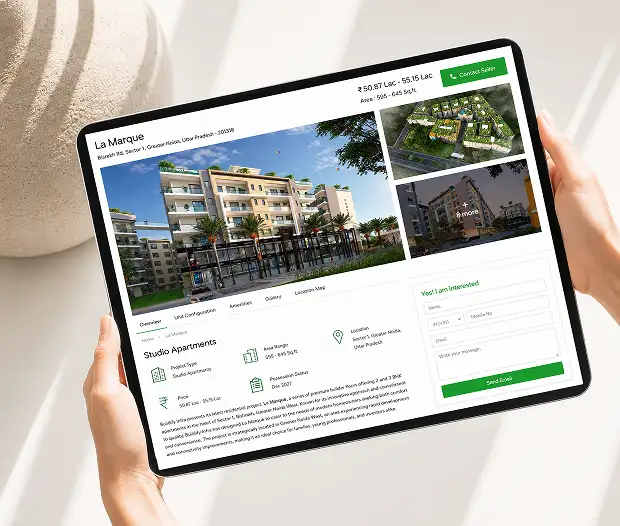
La Marque is Buildify Infra's premium builder-floor project in Sector 1, Bishrakh, Greater Noida West. The project offers 2 BHK and 3 BHK apartments across nine low-rise G+5 towers, with amenities spanning landscaped gardens, jogging tracks, a gymnasium, swimming pool, yoga space, and children's play areas. The product positioning targets young professional families, NRI buyers seeking NCR exposure, and mid-segment investors looking for builder-floor inventory at a price point below high-rise alternatives.
The engagement focused on building a high-velocity growth marketing system that could systematically test which audience layers and creative formats produced the highest qualified-lead rate at the lowest CPL. The brief was not single-burst lead generation but continuous, multi-axis audience experimentation, where 121 parallel campaigns formed a learning matrix that surfaced the winning combinations. Total managed ad spend across the engagement: ₹6,72,740.76.
The Challenge
Premium builder-floor projects in Greater Noida West sit in one of the most competitive residential submarkets in India. End-buyer demand exists, but the buyer base is fragmented across multiple distinct profiles, and competing inventory is abundant. Several structural conditions made simple, single-audience campaigns insufficient.
Key challenges included:
A fragmented buyer base spanning young professional families, NRI investors with NCR exposure intent, mid-segment first-time homebuyers, and government-sector employees (PSU buyers), each responding to different messaging stacks
Heavy competing inventory from large-format high-rise developers in the same micro-market, requiring competitive-audience targeting to intercept buyers actively comparing alternatives
Multiple creative formats (static, video, voice-over reels) needed to be tested in parallel rather than sequenced, because format effectiveness varies significantly by audience layer
A short three-month launch window requiring rapid experiment-cycle velocity, with no room for sequential audience-by-audience testing
A premium-priced product in a price-sensitive submarket, demanding tight CPL discipline alongside aggressive lead quality filtering
The core challenge was experiment velocity. With multiple audience layers, multiple creative formats, and a finite three-month window, the only viable strategy was running every audience-creative combination in parallel and letting performance data identify the winners rather than guessing in advance.
The Objective
The engagement was guided by three growth marketing objectives that operated in parallel.
The first objective was to identify and scale the highest-performing audience-creative combinations through systematic parallel testing rather than sequential A/B cycles. This required campaign architecture that could support a high simultaneous campaign count without losing per-campaign optimization quality.
The second objective was to sustain or improve qualified-lead rate as cumulative spend scaled. Most performance campaigns see QFL degrade as spend increases. The engagement was structured to actively counter this through audience precision and intent-qualifying lead forms, aiming for a benchmark of 35% QFL or higher.
The third objective was to hold CPL inside the price-band economics that a premium builder-floor product can support in a price-sensitive submarket, recognizing that Greater Noida West buyers compare aggressively across competing inventory and that CPL discipline directly determines campaign ROI.
Together, these objectives required a multi-axis experimentation architecture where audience targeting, creative format, and campaign structure were tested in parallel at high velocity, with budget continuously reallocated toward the winning combinations.
The Solution
The solution was designed as a high-velocity, multi-axis audience experimentation system. Rather than running a small number of campaigns with manual A/B sequencing, 121 parallel campaigns formed a learning matrix across five distinct audience layers and multiple creative formats.
Market-Informed Foundation
Research preceded execution. The Greater Noida West premium builder-floor buyer was mapped into distinct cohorts: young professional families (lifestyle-driven, value comparison), NRI buyers (NCR-exposure investors with longer evaluation cycles), first-time homebuyers (price-sensitive, financing-driven), government-sector employees (PSU loan eligibility, regulatory comfort), and competitor-comparison shoppers (already in-market, actively evaluating alternatives). Each cohort required differentiated audience targeting, messaging, and creative treatment.
Multi-Axis Audience Experimentation (Core Growth Loop)
Five distinct audience layers were tested in parallel across the campaign matrix:
LA & Demo
(Lookalike Audience + Demographics): Audience modeled on existing high-intent profiles, layered with demographic filters for buyer-stage relevance.
RE
(Real Estate Interest): Behavioral targeting of audiences actively engaging with real estate content on Meta platforms.
RE Comp
(Real Estate Competitor): Audiences indicating active interest in competing developments in the same micro-market, allowing the project to intercept buyers in comparison mode.
PSU
(Public Sector Undertaking): Government-employee targeting, leveraging buyer profiles with stable income, defined loan eligibility, and structured purchase decision-making.
Demographics
(Broad Demographic): Wider demographic targeting used as a volume layer and as a control for narrower audience performance comparison.
Each of these audience layers was run with multiple creative variants in parallel, producing a learning matrix where every audience-creative combination generated performance data simultaneously.
Multi-Format Creative Testing
In parallel with audience layering, multiple creative formats were tested:
VO Reel
(voice-over short-form video) used as the primary engagement-driving format
Static creatives for direct CTA-driven response
Standard video for narrative-driven storytelling
This allowed format effectiveness to be measured per audience layer rather than assumed. Some audiences responded best to VO Reel, others converted more efficiently on static, and the matrix surfaced those preferences without bias.
Parallel Sub-Brand Track
Alongside La Marque campaigns, a parallel sub-campaign track labelled "Phonex" ran with its own LA and Demographics audience splits. This parallel track served as an additional experiment surface, allowing brand-level creative and audience approaches to be tested independently of the main La Marque campaign labels.
High-Velocity Optimization
With 121 campaigns running across a three-month window, the optimization rhythm was compressed:
Daily performance scanning across the campaign matrix
Budget continuously reallocated toward the highest-performing audience-creative combinations
Underperforming combinations paused early to prevent budget leakage
Winning audience-creative combinations scaled into larger budget envelopes
Continuous creative refresh on the winning combinations to prevent fatigue
Quality-First Lead Gating
Lead forms were structured with intent-qualifying questions placed at the entry point so unqualified leads were filtered before reaching the sales team's call queue. This preserved the 35% qualified-lead rate target across the full ₹6.72L+ spend window, sustaining lead quality even as campaign count scaled.
The Impact
The high-velocity, multi-axis experimentation architecture delivered the highest qualified-lead rate across the full portfolio (35%) while sustaining a competitive ₹168 average CPL across 121 simultaneous campaigns.
Key outcomes included:
35% qualified-lead rate sustained throughout, the highest in the portfolio
Five distinct audience layers systematically tested in parallel rather than sequentially
Multiple creative formats validated per audience layer through parallel measurement
Budget continuously reallocated toward the winning audience-creative combinations
121-campaign architecture executed without loss of per-campaign optimization quality
Audience learnings captured at scale, transferable to future Buildify Infra launches
Quantified impact:
Metric | Value |
Total managed ad spend | ₹6,72,740.76 |
Leads generated | 4,000+ |
Qualified-lead rate (QFL) | 35% sustained (portfolio best) |
Reach | 7.14L+ unique Accounts Centre accounts |
Total impressions | 1.5M+ (15L+) |
Campaigns executed | 121 (portfolio high) |
Average cost per lead (CPL) | ~₹168 |
Audience layers tested | 5 (LA & Demo, RE, RE Comp, PSU, Demographics) |
Engagement duration | 3 months (November 2024 to February 2025) |
Overall, the engagement demonstrates how high-velocity, multi-axis audience experimentation can be operationalized inside premium residential real estate paid acquisition to produce the highest qualified-lead rate at the lowest possible CPL within a short launch window. The architecture is replicable for any developer operating in a competitive submarket where audience precision is the primary ROI lever.
Conclusion
This engagement illustrates what high-velocity growth marketing experimentation looks like when applied to a premium residential launch in a competitive NCR submarket. ₹6,72,740.76 in managed Meta Ads spend, deployed across 121 parallel campaigns testing five distinct audience layers and multiple creative formats simultaneously, generated 4,000+ leads at an average ₹168 cost per lead while achieving a 35% qualified-lead rate, the highest in the portfolio. By treating audience and creative testing as a parallel learning matrix rather than a sequence of A/B cycles, La Marque achieved both volume and quality benchmarks inside a three-month window. This is the operational outcome that high-velocity growth marketing experimentation is built to produce.
Ready to book a 30-minute strategy call?
We'll map the right digital moves for your real estate business, no pitch deck, no commitment.
No slides. No sales pitch. Just a focused strategy call.
More to read
More case studies

Social Media Strategy and Content Growth for a US Coliving Investment Brand
+813%
LinkedIn reactions
Driving Commercial Investment Leads with Search Ads for a Noida Landmark Project
3,100+
Clicks