

Honey Saxena
Digital Marketing Expert
Best Real Estate Lead Generation Tools 2026
Published July 22, 2026|10 min read
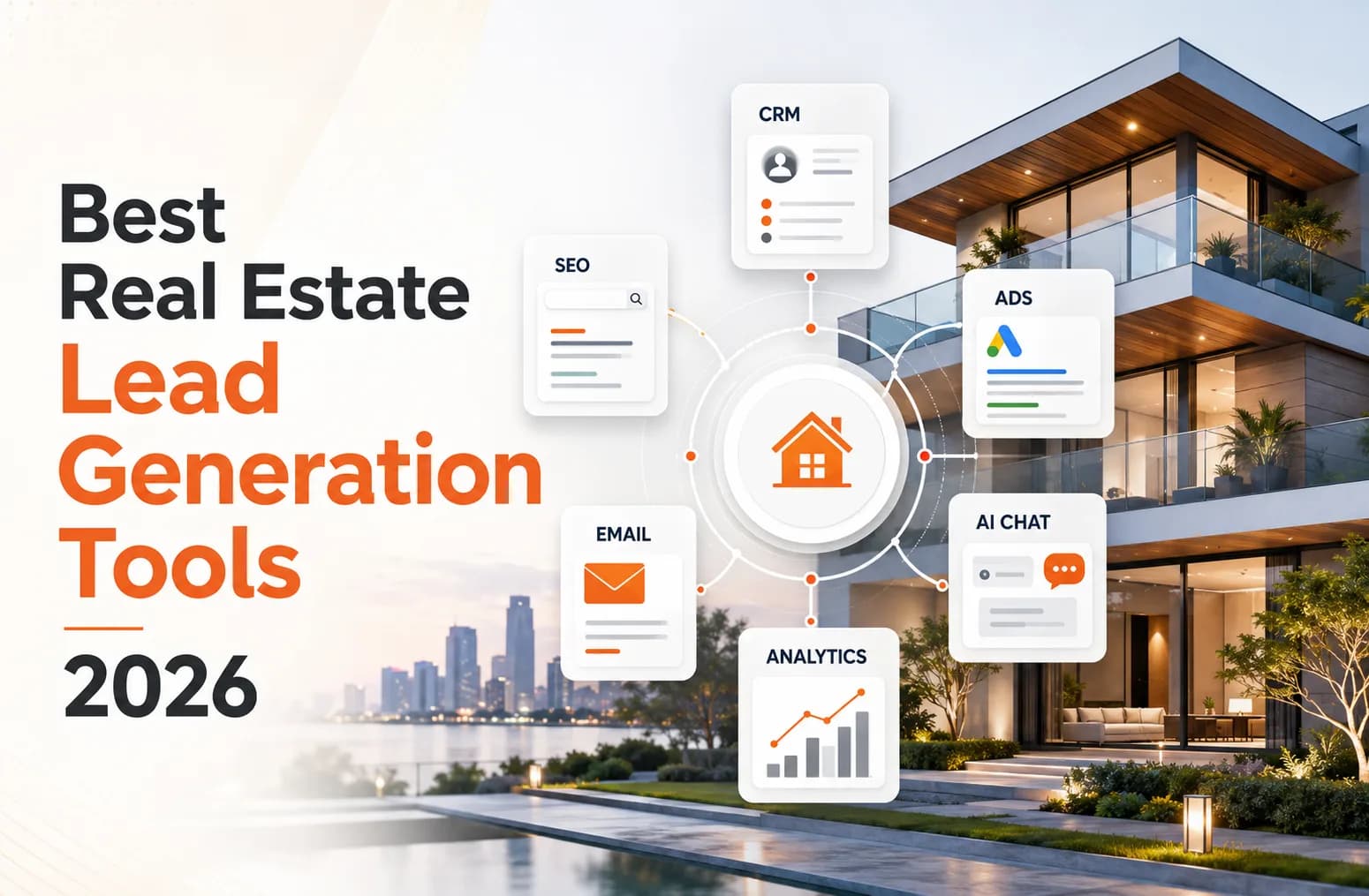
The ideal real estate lead generation toolkit combines a CRM, conversion-focused landing pages, Google and Meta advertising, SEO tools, interactive property calculators, automated email or WhatsApp follow-up and full-funnel analytics. The best stack is not the one with the most software. It is the smallest connected system that captures every enquiry, qualifies it, assigns an owner and tracks it through to a viewing, booking or completed transaction.
Why do real estate marketers need lead generation tools?
Real estate marketers manage leads from more sources than most ordinary sales teams. An enquiry may arrive through a property portal, Google advertisement, Meta form, website, telephone call, WhatsApp message, social media direct message or open-house registration.
Without a connected toolkit, these enquiries become scattered across:
Agent inboxes
Personal WhatsApp accounts
Spreadsheets
Portal dashboards
Advertising platforms
Website form notifications
Paper registration forms
That fragmentation creates delayed responses, duplicate communication, unclear ownership and weak attribution.
Technology can solve these problems, but adoption alone does not guarantee better performance. According to the National Association of REALTORS®’ 2025 Technology Survey, 75% of REALTORS® used social media, 52% used drone photography or video, and 46% used AI-generated content. The same survey found that 82% of clients responded positively or very positively when technology was integrated into the property journey. National Association of REALTORS®
The objective is not simply to add technology. It is to create a smoother path from initial interest to human conversation and eventual transaction.
What should a real estate lead generation stack include?
A complete stack should perform seven functions:
Attract relevant traffic
Convert traffic into enquiries
Capture every lead in one database
Qualify and prioritise prospects
Route leads to the correct agent
Nurture prospects over long buying cycles
Connect marketing activity with revenue
These functions usually require several connected tool categories:
Function | Tool category |
|---|---|
Demand generation | Google Ads, Meta Ads and social platforms |
Organic visibility | SEO, local search and content tools |
Conversion | Landing pages, forms, chat and calculators |
Lead management | CRM |
Communication | Email, SMS, WhatsApp and calling |
Automation | Workflow and integration platforms |
Measurement | Analytics, dashboards and CRM attribution |
You do not need a separate platform for every function. Many CRMs and marketing platforms overlap. Choose tools based on workflow fit, integration quality, team capacity and total cost.
Which CRM tools are best for real estate leads?
A CRM should be the foundation of the stack. It records where the lead came from, what they want, who owns the relationship and what should happen next.
HubSpot
HubSpot is suitable for brokerages, developers and PropTech companies that want CRM, forms, landing pages, email, advertising data and reporting within one ecosystem.
It is particularly useful when marketing and sales teams need a shared view of the funnel.
Consider HubSpot when you need:
Marketing and sales alignment
Website form capture
Email automation
Lead scoring
Pipeline reporting
Advertising attribution
Flexible integrations
The main consideration is cost as contacts, automation and feature requirements grow.
Salesforce
Salesforce suits larger brokerages, international developers, investment firms and property businesses with complex sales structures.
It can support:
Multiple projects and territories
Complex lead-assignment rules
Channel partner management
Custom approval workflows
Advanced reporting
Enterprise permissions
Bespoke integrations
Salesforce can be extremely flexible, but it requires careful configuration. An unstructured Salesforce implementation can become expensive and difficult for agents to use.
Zoho CRM
Zoho CRM is a practical option for small and mid-sized property businesses that want flexible workflows without immediate enterprise-level costs.
It supports:
Lead capture
Workflow automation
Email integration
Custom fields
Pipeline stages
Sales forecasting
Reporting
Zoho is particularly relevant for international teams that do not need a platform built exclusively around the US residential market.
Follow Up Boss
Follow Up Boss is designed for residential real estate teams and is especially useful when leads arrive from portals, IDX websites and multiple advertising sources.
Its strengths include:
Real estate lead routing
Agent accountability
Contact timelines
Automated action plans
Calling and texting
Portal integrations
It is a strong choice for agent teams that want industry-specific functionality without building complex workflows from scratch.
Lofty and BoldTrail
Lofty and BoldTrail combine several features, including CRM, websites, property search, marketing automation and lead management.
These platforms can reduce the number of vendors required by a residential team. However, marketers should evaluate data ownership, website flexibility, contract terms and whether the platform supports the organisation’s exact sales workflow.
Custom CRM
A custom CRM may be justified when the business has:
Unique project structures
Complex channel partner workflows
Several business units
International lead-routing requirements
Custom reservation or booking journeys
Proprietary lead-scoring models
Deep PMS, ERP or investor-platform integrations
Most small teams should configure an established CRM before considering a fully custom system.
Noseberry Digitals configures and integrates HubSpot, Salesforce, Zoho and custom systems through its real estate CRM and technology services.
Which advertising tools generate real estate demand?
Google Ads
Google Ads captures high-intent demand from users actively searching for a property, agent, location or service.
It is suitable for searches such as:
Apartments for sale in a location
Commercial property investment
Real estate agent near me
Home valuation service
Property management company
New development in a city
Useful Google Ads components include:
Search campaigns
Call campaigns
YouTube campaigns
Display remarketing
Performance Max
Conversion tracking
Enhanced conversions for leads
Google Ads should send traffic to a page that matches the keyword and advertisement. Do not send every campaign to the website homepage.
Meta Ads Manager
Meta Ads Manager supports campaigns across Facebook and Instagram. It is useful for visual property promotion, awareness, lead forms, video and remarketing.
Real estate marketers can use it for:
Development launches
Listing videos
Agent promotion
Seller lead generation
Open-house registration
Neighbourhood content
Retargeting website visitors
Housing advertisements may be subject to Meta’s Special Ad Category rules, which can limit certain targeting options. Campaign teams should review the current requirements for their country before launch.
LinkedIn Campaign Manager
LinkedIn is more relevant for:
Commercial property
PropTech software
Real estate investment
B2B property services
Corporate leasing
Family office outreach
Developer partnerships
The cost per lead can be higher than consumer social platforms, but the professional audience can be more relevant for high-value B2B transactions.
NAR found that digital advertising was the top source of quality leads for 12% of surveyed real estate professionals, while websites and email tools also contributed meaningful lead flow. National Association of REALTORS®
Which landing-page and form tools work best?
A landing page turns campaign traffic into an identifiable enquiry.
Unbounce
Unbounce is useful for marketers who need to build and test campaign-specific landing pages without changing the main website.
It supports:
Drag-and-drop page creation
A/B testing
Dynamic text
Form capture
Conversion reporting
Advertising integrations
HubSpot Landing Pages
HubSpot landing pages work well when the CRM and marketing automation already operate within HubSpot. Form submissions can immediately trigger lead assignment, scoring and nurture workflows.
Webflow and WordPress
Webflow and WordPress offer more control over design, content and SEO. They are suitable for property businesses that need permanent location pages, project pages, campaigns and content resources.
The quality depends on implementation. A poorly built WordPress page can be slower than a focused campaign tool, while a professionally developed site can support both organic visibility and conversion.
Typeform and Jotform
Typeform and Jotform are useful for:
Buyer requirement forms
Property valuations
Investor questionnaires
Viewing registrations
Seller onboarding
Rental applications
Event registrations
Keep the form length proportionate to the offer. A brochure form should not feel like a mortgage application.
Ask questions that help with qualification:
Preferred location
Property type
Budget
Timeframe
Purchase purpose
Financing status
Preferred contact method
How can real estate calculators capture leads?
Calculators convert financial questions into useful website interactions.
High-value calculator types include:
Mortgage payment calculator
Rental yield calculator
Property ROI calculator
Home affordability calculator
Stamp duty calculator
Cash-flow calculator
Cap rate calculator
Rent versus buy calculator
Property valuation estimator
For example, an investor may use an ROI calculator before requesting properties that meet a specific return target. A first-time buyer may calculate affordability before booking a consultation.
Noseberry Digitals offers a free real estate ROI calculator and more than 20 free real estate calculators and assessments.
For lead generation, follow a value-first flow:
Let the visitor enter the calculation data.
Show a useful initial result.
Explain the result clearly.
Offer a personalised property analysis.
Ask for contact information only for the personalised next step.
Hiding every result behind a form can reduce trust and completion rates.
Which SEO tools help generate property leads?
SEO tools help marketers identify what buyers, sellers and investors search for and whether the website can appear for those queries.
Google Search Console
Google Search Console shows:
Queries producing impressions and clicks
Indexed pages
Crawling issues
Core Web Vitals
Page performance
Internal and external links
It should be installed on every real estate website.
Google Business Profile
Google Business Profile helps agents, brokerages and property-management businesses appear in Google Search and Maps.
Keep the profile updated with:
Contact details
Service areas
Photographs
Opening hours
Reviews
Posts
Services
Website links
Semrush and Ahrefs
Semrush and Ahrefs help with:
Keyword research
Competitor analysis
Backlink analysis
Rank tracking
Content gaps
Technical audits
Location-based search opportunities
You do not necessarily need both. Select the platform that fits your team’s workflow and reporting requirements.
Screaming Frog
Screaming Frog is useful for technical website audits. It can identify:
Broken links
Missing titles
Duplicate content
Redirect chains
Canonical issues
Indexing directives
Image problems
Google Trends
Google Trends can show changes in interest for locations, property categories and housing questions. Use it to understand seasonality and compare broad topic demand.
SEO works best when research becomes useful content and commercially relevant pages. Read Noseberry Digitals’ real estate digital marketing and lead-generation guide for a complete channel strategy.
Which social media tools are useful for marketers?
Meta Business Suite
Meta Business Suite allows marketers to publish, schedule and review content across Facebook and Instagram. It also centralises some messages, notifications and performance data.
Buffer and Hootsuite
Buffer and Hootsuite help teams:
Schedule posts
Manage several accounts
Coordinate approvals
Monitor engagement
Review content performance
These platforms are more valuable when several agents, developments or locations need consistent publishing.
Canva and Adobe Creative Cloud
Canva is suitable for fast template-based production. Adobe tools provide deeper control over photography, video, illustration and brand systems.
Templates should support consistency without making every property look identical.
CapCut and Adobe Premiere Pro
Short-form video is central to property discovery. CapCut works well for quick social video production, while Premiere Pro provides more advanced editing and professional control.
NAR’s technology research found that social media was the leading quality-lead technology for 39% of surveyed REALTORS®, ahead of CRM at 23% and local MLS at 17%. NAR REALTOR® Technology Survey
Social media tools help with production and distribution, but the content still needs a defined audience, clear property information and a conversion path.
Which chat and conversational tools capture leads?
Website live chat
Live chat allows prospects to ask questions without completing a formal enquiry form.
It is helpful for:
Availability questions
Price requests
Viewing bookings
Location questions
Rental enquiries
Basic qualification
Tools include Intercom, HubSpot Chat, Tidio and Zendesk.
WhatsApp Business
WhatsApp is important in markets where property conversations frequently move to mobile messaging.
A structured WhatsApp workflow can:
Confirm enquiries
Share brochures
Send floor plans
Schedule viewings
Provide location details
Record conversation history
Whenever possible, connect WhatsApp with the CRM. Leads should not remain only in an agent’s personal account.
AI chatbots
AI assistants can answer common questions, qualify prospects and route enquiries outside normal business hours.
An AI assistant can ask:
Are you buying, renting or investing?
Which location interests you?
What is your budget?
When do you plan to move?
Do you require financing?
Would you like to book a viewing?
AI should handle structured early-stage tasks. Qualified and sensitive conversations should move to a human agent.
Which email and communication tools work best?
HubSpot and ActiveCampaign
HubSpot and ActiveCampaign support segmented email automation, behavioural triggers and nurture sequences.
Use them for:
New enquiry confirmation
Property recommendations
Project updates
Buyer education
Seller guidance
Viewing reminders
Re-engagement
Referral requests
Mailchimp
Mailchimp is suitable for simple newsletters, database communication and basic automated sequences. It can be sufficient for smaller teams with limited workflow complexity.
Twilio
Twilio supports programmable SMS, WhatsApp and calling. It is useful for larger or more technical operations that need communication embedded within custom workflows.
Calendly
Calendly reduces friction when scheduling:
Property viewings
Valuations
Agent consultations
Investor calls
Demo appointments
Calendar bookings should create or update a CRM record automatically.
Noseberry Digitals builds segmented sequences and CRM-connected workflows through its real estate email marketing service.
Which automation tools should marketers use?
Zapier
Zapier connects popular applications through trigger-and-action workflows.
Example:
When a Meta lead form is submitted, create a CRM record, assign an agent, send a confirmation email and notify the sales channel.
Zapier is relatively accessible for non-technical teams.
Make
Make supports more visual and complex automation flows. It is useful when workflows involve multiple branches, data transformation or several applications.
Native CRM automation
HubSpot, Salesforce and Zoho include their own workflow engines. Native automation is often more reliable when most of the process already exists inside the CRM.
Custom API integrations
Custom integrations are preferable when:
Lead volumes are high
Data is commercially sensitive
Several systems must stay synchronised
Error handling is critical
The business needs detailed audit logs
Standard connectors cannot support the workflow
Noseberry Digitals’ real estate systems integration service connects CRM, MLS, marketing automation, property systems, payments and reporting through one operational data layer.
Which analytics tools measure lead quality?
Google Analytics 4
GA4 helps marketers understand:
Traffic sources
Landing-page behaviour
Events
Conversion paths
Campaign performance
Audience engagement
Google Tag Manager
Google Tag Manager allows teams to configure tracking for:
Form submissions
Phone clicks
WhatsApp clicks
Brochure downloads
Calculator completions
Viewing bookings
Video engagement
Looker Studio
Looker Studio can combine website, advertising and CRM data into a shared marketing dashboard.
CRM attribution
CRM attribution connects the original lead source to pipeline and revenue.
Without CRM outcomes, an advertising platform may optimise for easy form submissions rather than qualified buyers. Feed downstream statuses back into reporting wherever possible.
Measure:
Cost per lead
Valid-lead rate
Cost per qualified lead
Lead-to-appointment rate
Appointment-to-viewing rate
Viewing-to-offer rate
Customer acquisition cost
Revenue by source
Return on advertising spend
How should marketers choose the right tools?
Evaluate every tool against the same criteria.
Does it solve a real workflow problem?
Do not purchase software simply because a competitor uses it.
Does it integrate with the CRM?
A strong standalone tool can still create problems if data must be exported manually.
Can the team use it consistently?
An advanced platform with low adoption provides less value than a simpler system the team uses every day.
Does it support your markets?
Check language, currency, communication channels, data storage and regional advertising requirements.
Who owns the data?
Confirm how contacts, property data, content and history can be exported if the subscription ends.
What is the total cost?
Include:
Subscription fees
Contact limits
User licences
Implementation
Integration
Training
Maintenance
Support
Migration costs
Can it demonstrate revenue impact?
The tool should contribute to a measurable improvement in acquisition, response, qualification, conversion or reporting.
NAR found that 34% of REALTORS® spent an average of $50 to $250 per month on technology, while 20% spent between $251 and $500. Cost alone did not determine effectiveness. Integration and daily usage matter more than the number of subscriptions.
What is the ideal tool stack by business size?
Business type | Recommended starting stack |
|---|---|
Solo agent | CRM, Google Business Profile, website forms, social scheduler, email and calendar |
Small agent team | Real estate CRM, IDX website, Meta and Google Ads, WhatsApp, automation and GA4 |
Brokerage | CRM, lead routing, portal integrations, marketing automation, call tracking and attribution |
Property developer | CRM, project landing pages, Google and Meta Ads, WhatsApp, lead scoring and dashboards |
Property manager | CRM, local SEO, landlord landing pages, email automation, booking tools and call tracking |
PropTech company | HubSpot or Salesforce, product analytics, paid acquisition, content SEO and sales automation |
Enterprise operator | Enterprise CRM, custom integrations, data warehouse, BI dashboards and AI qualification |
Start with the essential workflow. Add more specialised tools only when lead volume, team size or campaign complexity justifies them.
What are the biggest tool-stack mistakes?
Buying before mapping the funnel
Tools should support a defined process. They cannot compensate for unclear lead stages or ownership.
Using several sources of truth
Marketing, sales and management should not maintain separate lead databases.
Automating generic messages
Automation should use the lead’s property, location, source and stage to create relevant communication.
Ignoring failed integrations
Connectors can silently break. Monitor automation errors and maintain fallback alerts.
Tracking only form submissions
A submitted form is not the final business outcome. Track qualification, viewings, offers and transactions.
Adding too many tools
More subscriptions create more data movement, training and failure points.
Neglecting privacy and advertising rules
Collect only necessary information, obtain appropriate consent and apply local privacy, housing and marketing regulations.
What is the best real estate lead generation toolkit?
For most property teams, the ideal starting stack contains five connected components:
A CRM as the single source of truth
A conversion-focused website with landing pages and forms
Google Ads, Meta Ads and organic search for acquisition
Email, SMS or WhatsApp automation for response and nurture
Analytics connected to qualified leads and revenue
Add calculators, AI chat, call tracking, social scheduling and custom integrations once the core system is working reliably.
The best tool is not necessarily the platform with the longest feature list. It is the platform that fits your sales process and transfers accurate data to the next stage without manual work.
- Start with a CRM as the central source of truth for every lead and interaction.
- Use Google Ads for high-intent demand and social platforms for discovery and remarketing.
- Add landing pages, chat and calculators to convert website traffic into useful lead data.
- Connect all tools through automation so leads receive immediate, relevant responses.
- Measure qualified leads, viewings, opportunities and revenue instead of only form submissions.
Why trust Noseberry
Our content is written by practicing real-estate and PropTech professionals, fact-checked by a dedicated editorial team, and reviewed against the latest industry data before publication.
- 10+ years of industry expertise
- All facts independently verified
- No sponsored rankings in guides
- Updated when the industry changes
Frequently asked questions
What is the best real estate lead generation tool?
There is no single best tool. A CRM such as HubSpot, Salesforce, Zoho or Follow Up Boss should form the foundation, supported by landing pages, advertising, communication automation and analytics.
What is the best CRM for real estate marketers?
HubSpot is strong for connected marketing and sales, Salesforce for enterprise customisation, Zoho for flexible value and Follow Up Boss for residential agent teams. The right choice depends on team size, geography and workflow.
Are free lead generation tools useful?
Yes. Google Search Console, Google Business Profile, GA4, Looker Studio and free CRM tiers can provide meaningful value. Free plans may have limits on automation, contacts, reporting or integrations.
Which tools generate seller leads?
Google Ads, local SEO, Google Business Profile, home valuation forms, market reports, seller guides, Meta campaigns and CRM nurture sequences can generate seller leads.
Can AI tools generate real estate leads?
AI tools can engage, qualify, score and route leads. They work best when connected to genuine traffic sources, accurate property data and a CRM. AI does not replace the need for a clear offer or professional human follow-up.
Related insights
 Real Estate
Which Company Builds Custom CRM Software for Real Estate Developers? Noseberry Digitals' Approach
This blog answers which company builds custom CRM software for real estate developers and makes the case for Noseberry Digitals as that partner. It explains why basic CRM platforms fall short for developers, covering unit inventory, investor reporting, and channel partner commission splits that standard tools weren't built to handle. It walks through Noseberry's seven-phase build process, its zero data-loss migration record, and a real named case study involving Zoho CRM automation for a coliving brand. The piece includes a comparison table weighing off-the-shelf platforms, basic dev shops, and a real estate specialist against each other. It closes with compliance considerations around RERA and Fair Housing rules, plus a 10-question FAQ section for fast reference.
September 5, 2026 Real Estate
App Store Optimization (ASO) for Real Estate and PropTech Apps
App Store Optimization for real estate and proptech apps isn't a launch-week checklist. It's an ongoing habit. It's built on precise keyword mapping, screenshots that show real use cases, a review timing plan, and metadata that stays honest as the app grows. Teams that treat their listing as a living asset, tested every quarter, tend to out-rank competitors with bigger budgets and bigger dev teams.
September 4, 2026 Real Estate
Influencer and Creator Marketing for Real Estate Brands: Beyond the Listing Video
This blog breaks down influencer marketing and creator marketing for real estate brands as two distinct strategies, not one interchangeable tactic. It explains the difference between paying for an influencer's existing audience versus paying a creator for original content your brand can reuse. It covers six content formats that outperform a basic listing walkthrough, from neighborhood guides to buyer testimonial clips. It compares running these partnerships in-house against hiring a specialized agency, with real cost and speed benchmarks. It closes with FTC disclosure and Fair Housing compliance rules every real estate brand needs before its next sponsored post.
September 2, 2026
Ready to book a 30-minute strategy call?
We'll map the right digital moves for your real estate business, no pitch deck, no commitment.