

Honey Saxena
Digital Marketing Expert
How to Market a Real Estate Agent in 2026
Published July 21, 2026|10 min read
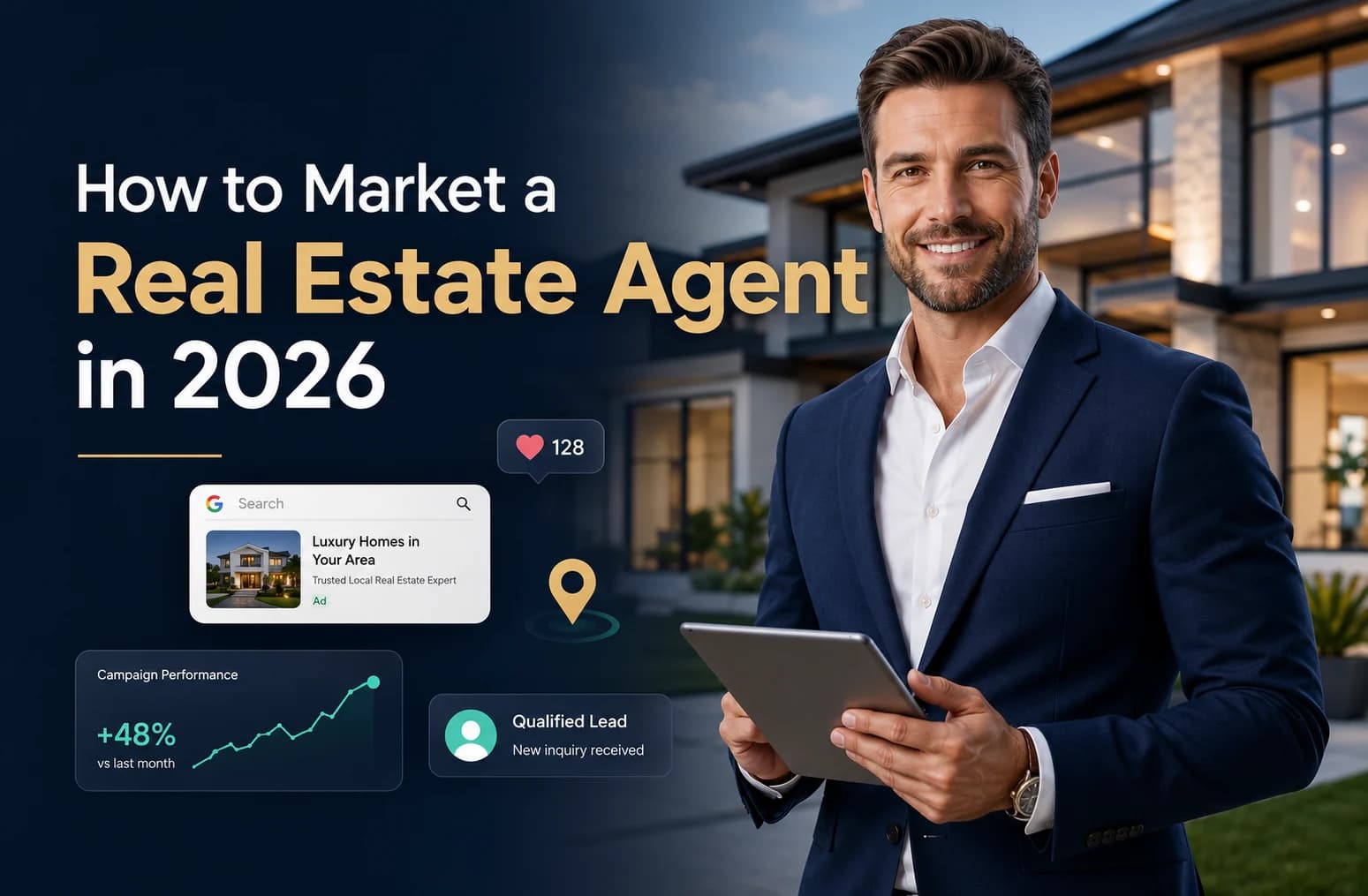
The best ways to market a real estate agent in 2026 are to build a recognisable local brand, optimise for local search, publish useful property content, showcase listings through video, generate reviews, run targeted advertising and nurture every enquiry through a CRM. The strongest strategy combines digital visibility with local relationships, helping the agent remain visible from a prospect’s first search until they are ready to buy or sell.
Why does marketing matter for a real estate agent?
Real estate is a trust-based, location-driven business. Buyers and sellers do not select an agent only because they have seen one advertisement. They often research the agent’s experience, reviews, listings, local knowledge, content and professional presence before making contact.
Marketing gives an agent repeated visibility throughout this research process. It helps potential clients understand:
Which locations the agent serves
What property categories they specialise in
.
Marketing gives an agent repeated visibility throughout this research process. It helps potential clients- Whether they work primarily with buyers, sellers, landlords or investors
What makes their service different
Whether previous clients trust them
How easily they can be contacted
The opportunity is significant. According to the National Association of REALTORS®, a record 91% of sellers used a real estate agent in 2025, while only 5% completed a For Sale By Owner transaction. Agent-assisted homes also recorded a median sale price of $425,000 compared with $360,000 for FSBO properties. These figures show that sellers continue to recognise the practical value of professional representation. National Association of REALTORS®
However, high demand for agents also means strong competition. An agent needs a distinctive and consistent marketing system to become the trusted choice within their market.
How should a real estate agent define their target market?
Before selecting channels, an agent should decide who they want to attract. Marketing aimed at “anyone interested in property” usually becomes too generic to be memorable.
Define the target market using four factors:
Geographic area
Choose the cities, neighbourhoods, communities or developments where you have experience and can realistically serve clients.
Customer type
Identify whether you want to attract:
First-time buyers
Homeowners preparing to sell
Property investors
Landlords
Tenants
Luxury buyers
International buyers
Commercial property clients
Developers and builders
Property category
An agent can specialise in apartments, villas, luxury residences, land, rentals, student accommodation, commercial property or investment property.
Customer motivation
A family relocating for schools needs different information from an investor calculating rental yield. Marketing messages should address the motivations and objections of each target group.
A useful positioning statement could be:
I help growing families find and purchase three and four-bedroom homes in Greater Noida West, with clear guidance on neighbourhoods, pricing, financing and the complete buying process.
This is more credible and memorable than simply saying, “I help people buy and sell property.”
How can a real estate agent build a strong personal brand?
A personal brand is the consistent impression people form whenever they encounter the agent online or offline. It should communicate expertise, personality, service standards and local relevance.
Build the brand around:
A professional headshot
Consistent colours and typography
A clear positioning statement
Professional listing photography
A recognisable tone of voice
Defined areas of specialisation
Consistent profile information
A strong agent biography
Proof of results and experience
The goal is not to make every piece of content look identical. The goal is to ensure clients can recognise the agent and understand what they represent.
Avoid relying on generic graphics containing motivational property quotes. Original market insights, neighbourhood videos, listing walkthroughs and client stories provide much stronger evidence of expertise.
How does local SEO help market a real estate agent?
Local SEO helps an agent appear when people search for services in a particular area, such as “real estate agent near me,” “estate agent in Leicester” or “property agent in Dubai Marina.”
Start by claiming and completing the agent or brokerage’s Google Business Profile. Google explains that a verified Business Profile lets a company manage how its address, contact information, business type and photographs appear across Google Search and Maps. Google Search Central
The profile should include:
Correct business name
Service areas
Address, where applicable
Phone number
Website
Opening hours
Business category
Professional photographs
Current service descriptions
Regular updates
Genuine client reviews
The agent’s website should also contain useful location pages. Each page should provide original information about the area rather than repeating the same template with a different place name.
A valuable neighbourhood page can cover:
Current property types
Typical price ranges
Transport links
Schools
Local amenities
Lifestyle
Rental demand
Recent developments
Frequently asked questions
Available properties
A clear enquiry option
Google describes SEO as helping search engines understand a website while helping users decide whether they should visit it. Therefore, neighbourhood pages should be written for genuine client needs, not simply filled with place-name keywords. Google SEO Starter Guide
What content should a real estate agent publish?
Content should answer the questions potential buyers and sellers ask before contacting an agent.
Useful topics include:
What is my home worth?
Is now a good time to sell?
How long does it take to buy a property?
Which neighbourhood is best for families?
What costs should first-time buyers expect?
Should investors choose capital growth or rental yield?
How should a property be prepared for viewings?
What mistakes delay a property sale?
What documents are required to purchase a home?
How do mortgage rates affect affordability?
Use a combination of:
Blog posts
Neighbourhood guides
Market updates
Short videos
Email newsletters
Buyer and seller checklists
Property comparisons
Case studies
Frequently asked questions
Noseberry Digitals’ guide to real estate content marketing in 2026 explains how agents can organise these ideas into repeatable content pillars.
One detailed article can also be repurposed into several social posts, a video, an email and a downloadable checklist. This makes content production more efficient.
How can social media market a real estate agent?
Social media works best when it shows the agent’s knowledge, personality and active involvement in the local property market.
NAR’s 2025 technology research found that 75% of REALTORS® used social media, making it one of the most widely adopted technologies in the profession. The same research found that 52% used drone photography or video, highlighting the importance of visual property marketing. NAR REALTOR® Technology Survey
A balanced social media calendar can include:
New property tours
Recently sold properties
Neighbourhood features
Market statistics
Buying and selling tips
Client testimonials
Frequently asked questions
Behind-the-scenes content
Open-house announcements
Property renovation ideas
Agent introductions
Local business features
Video is particularly useful because it allows prospects to see both the property and the agent. Record short, direct videos that answer one question at a time.
For example:
“Three things buyers should know about this neighbourhood”
“Why this property has been on the market for 60 days”
“What £400,000 buys in Leicester”
“How to prepare your home for a valuation”
Read the complete social media marketing guide for real estate agents for platform and content-planning recommendations.
How can an agent use reviews and referrals?
Reviews reduce perceived risk. They show that previous clients trusted the agent with an important financial and personal decision.
Ask for a review after a successful milestone, such as:
Property completion
Accepted offer
Successful rental placement
Completed valuation
Positive consultation
Resolved client issue
Make the request personal and provide a direct link to the review platform. Never purchase reviews or pressure clients to write only positive feedback.
Testimonials are more useful when they explain the client’s original problem, the agent’s actions and the final result. With the client’s permission, turn strong testimonials into website case studies and social media content.
Agents should also maintain relationships with:
Mortgage brokers
Conveyancers and lawyers
Property photographers
Developers
Interior designers
Relocation consultants
Accountants
Landlords
Previous clients
Local business owners
These relationships can create qualified referrals that are difficult for competitors to reproduce through paid advertising alone.
What free tools can help an agent generate leads?
Interactive tools can turn an agent’s website into a useful resource rather than a digital brochure.
Useful tools include:
Mortgage calculator
Property valuation estimator
Rental yield calculator
Stamp duty calculator
Home affordability calculator
ROI calculator
Rent versus buy calculator
For example, an investor reading a neighbourhood guide could use a rental yield calculator and then request suitable properties. A buyer could calculate monthly mortgage payments before booking a viewing.
Noseberry Digitals provides free real estate calculators and assessment tools, including mortgage, affordability, valuation, rental yield and ROI calculators. These tools can also help agents identify which interactive resources would be valuable on their own websites.
How should paid advertising be used?
Paid advertising can create immediate visibility while SEO, referrals and organic content build longer-term demand.
Use Google Search Ads to reach people actively searching for:
An agent in a specific location
A home valuation
Properties within a price range
Investment opportunities
Rental management
Specific developments or communities
Use Meta and Instagram advertising for:
Listing videos
Agent introductions
Neighbourhood campaigns
Seller lead generation
Remarketing
Open-house promotion
Downloadable property guides
Every advertisement should direct visitors to a relevant landing page, not a generic homepage. The page should continue the same message, clearly explain the offer and make the next action easy.
Noseberry Digitals’ real estate ad creative and landing-page playbook provides a detailed framework for connecting advertisements with conversion-focused pages.
How should agents nurture enquiries?
Not every prospect is ready to transact immediately. Some buyers may need financing, while sellers may wait several months before listing.
A real estate CRM should capture:
Contact information
Original lead source
Preferred location
Property type
Budget
Transaction timeframe
Previous conversations
Follow-up date
Current pipeline stage
Email, SMS and WhatsApp can then be used to share relevant listings, neighbourhood updates, valuation reminders and market insights.
The objective is not to send constant promotional messages. It is to remain useful and visible until the prospect is ready to take action.
How should a real estate agent measure marketing success?
Avoid judging marketing only through reach, followers or website traffic.
Track metrics connected to business development:
Website enquiries
Phone calls
Valuation requests
Qualified buyer leads
Listing appointments
Viewing bookings
Cost per qualified lead
Signed listings
Completed transactions
Referral enquiries
Revenue by marketing source
Use consistent tracking links and record the original source of every lead in the CRM. Review performance monthly and invest more in the channels producing qualified appointments and transactions.
Agents can begin by completing Noseberry Digitals’ free real estate marketing audit to identify weaknesses across strategy, paid media, organic visibility, content, email, social media and branding.
What is the best way to market a real estate agent in 2026?
The best strategy is to combine local specialisation, a strong personal brand, search visibility, educational content, social proof, video, referrals, paid promotion and organised follow-up.
An agent does not need to publish on every platform. It is better to dominate one geographic market and operate a dependable conversion system than to maintain a weak presence across every available channel.
Noseberry Digitals helps brokerages and agents connect branding, websites, SEO, content, performance marketing, CRM, and automation into one growth system. Explore our digital marketing services for real estate and solutions for real estate brokerages.
Find out what is limiting your real estate marketing
Complete the free Real Estate Marketing Audit to assess your brand, SEO, content, paid media, social presence, and lead-nurturing system.
- Build your marketing around a specific location, audience, and property category.
- Optimise your website and Google Business Profile for local searches.
- Use educational content and video to demonstrate expertise, not just advertise listings.
- Give prospects useful tools such as mortgage, valuation and ROI calculators.
- Track qualified leads, appointments, valuations and transactions instead of only followers or clicks.
Why trust Noseberry
Our content is written by practicing real-estate and PropTech professionals, fact-checked by a dedicated editorial team, and reviewed against the latest industry data before publication.
- 10+ years of industry expertise
- All facts independently verified
- No sponsored rankings in guides
- Updated when the industry changes
Frequently asked questions
What is the cheapest way to market a real estate agent?
The cheapest methods include optimising a Google Business Profile, requesting client reviews, publishing local content, creating short videos, building referral partnerships and maintaining an email database.
Which social platform is best for real estate agents?
Instagram is effective for property visuals and short videos, Facebook supports local communities and remarketing, LinkedIn suits commercial property and professional referrals, while YouTube supports longer property and neighbourhood content.
How often should a real estate agent post online?
A sustainable schedule of three useful social posts per week, one regular video and two detailed articles per month can be more effective than posting low-value content every day.
Does a real estate agent need a personal website?
Yes. A personal website gives the agent control over their brand, content, lead capture, local SEO, analytics and client experience. Social profiles and portal listings should support the website, not replace it.
How can an agent attract more property sellers?
Publish valuation content, promote local sales results, collect seller testimonials, offer a valuation request, explain the selling process and run location-specific search or social campaigns.
Should real estate agents use paid ads?
Paid ads can be valuable when the agent has a clear audience, a competitive offer, dedicated landing page, conversion tracking and a reliable follow-up process. Advertising should not be used to compensate for unclear positioning or a weak website.
Related insights
 Real Estate
App Store Optimization (ASO) for Real Estate and PropTech Apps
App Store Optimization for real estate and proptech apps isn't a launch-week checklist. It's an ongoing habit. It's built on precise keyword mapping, screenshots that show real use cases, a review timing plan, and metadata that stays honest as the app grows. Teams that treat their listing as a living asset, tested every quarter, tend to out-rank competitors with bigger budgets and bigger dev teams.
September 4, 2026 Real Estate
Influencer and Creator Marketing for Real Estate Brands: Beyond the Listing Video
This blog breaks down influencer marketing and creator marketing for real estate brands as two distinct strategies, not one interchangeable tactic. It explains the difference between paying for an influencer's existing audience versus paying a creator for original content your brand can reuse. It covers six content formats that outperform a basic listing walkthrough, from neighborhood guides to buyer testimonial clips. It compares running these partnerships in-house against hiring a specialized agency, with real cost and speed benchmarks. It closes with FTC disclosure and Fair Housing compliance rules every real estate brand needs before its next sponsored post.
September 2, 2026 Real Estate
Real Estate Digital Agency in USA: How Noseberry Digitals Helps Developers & PropTech Companies Grow
This blog explains what makes Noseberry Digitals a real estate digital agency in USA built for developers and proptech companies. It covers why generalist agencies struggle with real estate-specific needs like MLS integrations and multi-market brand consistency. It walks through the agency's full-stack services, from branding and websites to CRM, AI, and a 60-day proptech MVP program. It highlights named, documented case studies with real client results, something the piece notes is rare among proptech marketing agencies. It closes with a practical checklist for choosing a real estate digital agency and clears up whether Noseberry Digitals is itself a proptech company.
August 27, 2026
Ready to book a 30-minute strategy call?
We'll map the right digital moves for your real estate business, no pitch deck, no commitment.