

Mayank Pokharna
COO, Noseberry Digitals & Industry Expert
Automated Valuation Models (AVMs) in Real Estate: How They Work and How Accurate They Really Are
Published July 22, 2026|12 min read
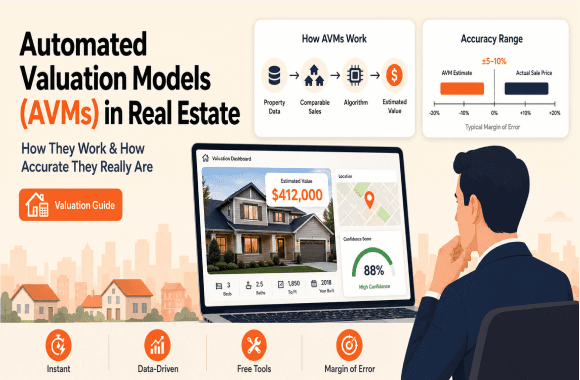
Automated valuation models can estimate millions of property values in seconds. Their accuracy depends on recent sales, complete property data, and market liquidity. Listed homes often receive tighter estimates than off-market or unusual properties. This guide explains AVM methods, accuracy metrics, limitations, regulation, and testing. It also gives real estate teams a practical framework for responsible AVM use.
Automated valuation models estimate a property's market value by analysing property records, recent sales, location, and market behaviour. They can be highly accurate for standard homes in active markets, but they become less reliable when data is thin, outdated, or unable to capture a property's true condition. An AVM should support a valuation decision, not make every decision alone.
For real estate companies, the real question is whether the estimate is current, explainable, tested, and paired with a confidence range. Modern real estate AI platforms increasingly show comparable sales, data freshness, confidence, and human review triggers.
Across a decade building real estate technology, our team has seen that users trust estimates they can understand. Clear evidence often feels more credible than unexplained precision.
What is an automated valuation model in real estate?
An automated valuation model in real estate is software that estimates a property's market value using statistical methods, machine learning, and structured property data. It can evaluate a home in seconds, apply one methodology consistently, and process far more properties than a human valuation team could inspect manually.
An AVM combines public records, recent transactions, listing data, property attributes, neighbourhood information, and market trends. Advanced models may also use rental data, imagery, geospatial features, hazards, and economic indicators.
A useful output includes an estimated value, valuation range, confidence score, comparable transactions, data freshness, and warnings about missing information.
An automated valuation model is a decision-support system because uncertainty matters as much as the estimate. A statistically strong model can still fail if users cannot interpret its result.
This is why teams building custom AI solutions for real estate must design the model, data pipeline, confidence logic, and user experience together.
How do automated valuation models work?
Automated valuation models work by turning property and market data into measurable features, comparing the target property with relevant transactions, and applying a statistical or machine learning model. The system then estimates value, calculates uncertainty, and may reject the case when the available evidence is too weak.
A typical AVM follows seven steps:
Collect data. Ingest transactions, listings, floor area, rooms, lot size, age, and property type.
Clean records. Resolve duplicates, inconsistent addresses, missing fields, and non-market transactions.
Create location features. Measure access, amenities, hazards, and neighbourhood context.
Select comparables. Identify recent sales with similar physical and local characteristics.
Estimate value. Apply regression, tree models, neural networks, or an ensemble.
Measure uncertainty. Calculate a confidence score or prediction range.
Apply review rules. Send unusual, high-risk, or low-confidence cases to a person.
The hardest part is rarely the algorithm. Data quality, address matching, transaction filtering, and comparable selection often have a greater practical effect.
That is why an AVM needs a well-designed real estate data and analytics platform, not only a trained model. The platform must manage ingestion, lineage, validation, monitoring, access controls, and user-facing explanations.
What data matters most for AVM performance?
Recent arm's-length sales usually carry the strongest signal. Floor area, property type, age, rooms, parking, condition, listing history, and micro-location features explain why nearby homes sell at different prices.
Renovation data remains a common blind spot. An AVM may treat two homes as equal even when one has an extension, energy upgrade, or major maintenance problem.
How accurate are automated valuation models in real estate?
AVM accuracy varies by property, market, data freshness, and use case. Current vendor figures show that listed homes can receive median errors below 2 percent, while off-market homes may be closer to 7 percent. The difference exists because an active listing provides newer and richer property information.
Redfin currently reports a median error rate of 1.85 percent for on-market homes and 7.24 percent for off-market homes. It says the model uses more than 500 data points across about 92 million US homes. These vendor figures are product claims, not universal AVM benchmarks.
What does a 7.24 percent median error mean? It means half of the relevant estimates were closer than 7.24 percent to the final sale price, while half were farther away. It does not mean every property estimate falls inside that range.
For a $400,000 property, 7 percent equals $28,000. For an $800,000 property, it equals $56,000. An automated valuation model real estate user should examine both the percentage and monetary consequence.
Which AVM accuracy metrics should you check?
A single average can hide weaknesses. Strong AVM reporting uses:
Median absolute percentage error, or MdAPE: The middle percentage difference between estimated value and sale price.
Mean absolute error, or MAE: The average currency difference between estimates and actual prices.
Hit rate: The percentage of eligible properties for which the model returns a value.
Tolerance rate: The percentage of estimates within 5 percent, 10 percent, or another defined limit.
Directional bias: Whether the model regularly overvalues or undervalues properties.
Segment accuracy: Performance by geography, property type, price band, and transaction volume.
Prediction interval coverage: Whether the confidence range contains actual sale prices as often as promised.
Accuracy should be measured on unseen transactions. Otherwise, the score may describe memory rather than prediction.
Why does AVM accuracy vary by property and market?
AVM accuracy varies because property data is uneven. A standard apartment in an active urban market may have dozens of useful comparable sales. A rural estate, renovated townhouse, penthouse, or architect-designed home may have none. The estimate becomes less dependable as evidence becomes thinner.
AVMs usually perform best when:
The property is common for its local market
Several similar properties sold recently
Public records and listing data agree
Floor area and property attributes are complete
The local market is relatively stable
Major renovations have been recorded
They usually struggle when:
The home is unique, rural, luxury, mixed-use, or newly built
Few nearby transactions are available
Prices are moving quickly
Public sale records arrive late
Condition or renovation details are missing
Street-level differences are hidden inside broad location data
Andrew Knight, AI, data and tech lead at RICS, puts the limitation clearly: “AVMs work best with widely traded, homogenous assets.” Performance declines when properties are more varied or transactions are scarce.
A 2025 Urban Institute study by Linna Zhu, Judah Axelrod, and Amalie Zinn found that disparities can arise from historical data and model design. National accuracy is not enough. Models should be tested across locations, property segments, and demographic contexts.
AVM vs appraisal vs comparative market analysis
An AVM, professional appraisal, and comparative market analysis answer related valuation questions, but they use different evidence and levels of human judgement. The correct method depends on risk, complexity, speed, data, and legal requirements.
Method | Typical speed | Physical inspection | Best use | Main limitation |
Automated valuation model | Seconds to minutes | No | Screening, portfolio monitoring, lead qualification, early pricing | Can miss condition, renovations, and unusual features |
Comparative market analysis | Hours to days | Sometimes | Listing strategy and local agent advice | Quality depends on local expertise and comparable selection |
Professional appraisal | Days | Usually yes | Lending, disputes, complex or high-value decisions | Higher cost and slower turnaround |
An AVM is strongest when speed, consistency, and scale matter. An appraisal is strongest when condition, uniqueness, legal defensibility, or risk matters.
An investor screening 10,000 homes needs automation. A lender reviewing a complex mortgage may need an appraiser. A custom real estate software platform can process high-confidence cases and send exceptions to reviewers.
Who uses AVMs, and when should they use them?
Lenders, investors, brokerages, portals, insurers, and PropTech companies use AVMs when they need fast estimates. AVMs work best for screening and monitoring. They are less suitable as the only evidence for unusual or high-stakes properties.
Mortgage lending and home equity
Lenders use AVMs to assess collateral, monitor loan-to-value ratios, support underwriting, and identify cases that need a full appraisal.
In the United States, six agencies issued a federal AVM quality-control rule, effective October 1, 2025. Covered institutions must support confidence, protect data, manage conflicts, perform sample testing, and comply with nondiscrimination laws.
Property portals and seller tools
Property portals use AVMs to give homeowners an instant estimate, attract seller leads, and support property search. The estimate should be labelled as a starting point rather than a guaranteed selling price.
Our guide to AI in real estate applications explains how valuation models fit alongside listing generation, lead scoring, buyer support, fraud detection, and predictive analytics.
Real estate investment and portfolio monitoring
Investors use AVMs to compare asking prices with estimated values, track portfolio equity, rank acquisitions, monitor loan-to-value changes, and test market scenarios.
An institutional investor may value thousands of assets weekly. A homeowner may request one estimate occasionally. The same output should not carry identical decision authority in both situations.
PropTech products and valuation APIs
AVM providers often expose values, comparables, ranges, and confidence scores through APIs. Production services need reliable real estate API development, versioning, audit logs, monitoring, and clear confidence-field documentation.
How should a real estate company test and govern an AVM?
A real estate company should test an AVM on recent, unseen sales and report performance by geography, property type, price band, and market liquidity. Governance should cover data lineage, model versions, confidence thresholds, fairness, monitoring, exceptions, and documented human review. One national error rate is never enough.
A practical AVM validation framework includes:
Define the decision. State whether the model supports marketing, lending, acquisition, taxation, or portfolio monitoring.
Set an acceptable error. Translate percentage error into a monetary and risk threshold.
Create a time-based test set. Validate the model on later transactions that were unavailable during training.
Segment the results. Review urban, suburban, rural, luxury, new-build, and low-volume markets separately.
Test directional bias. Check whether the model systematically overvalues or undervalues a property group.
Calibrate confidence ranges. Confirm that stated intervals contain actual sale prices at the promised rate.
Create abstention rules. Allow the model to return “insufficient confidence” instead of forcing a weak estimate.
Monitor model drift. Recheck performance as transaction volumes, interest rates, inventory, and local prices change.
Record every version. Keep training dates, feature definitions, code versions, approvals, and validation results.
Route exceptions to people. Use qualified reviewers for unusual, disputed, high-value, or regulated cases.
In our experience, trustworthy AVM products know when the evidence is too weak.
A strong architecture also requires connected systems. Real estate systems integration keeps listings, property records, CRM data, analytics, and model outputs consistent. Stale or conflicting information quietly reduces accuracy.
Teams planning a wider AI programme can use an AI implementation roadmap for real estate firms to sequence data preparation, pilot testing, governance, rollout, and monitoring.
Conclusion: AVMs are powerful when uncertainty stays visible
The key takeaway is simple: an automated valuation model can deliver fast and consistent property estimates, but its accuracy depends on the evidence available for that exact property, place, and moment.
Current vendor data shows why context matters. Redfin reports a median error below 2 percent for on-market homes, where fresh MLS and listing details are available. Its off-market median error is above 7 percent. On a high-value property, that difference can affect lending, pricing, acquisition, and portfolio decisions.
Treat an AVM as a probability-based estimate, not a fixed fact. Review the confidence range, recent comparable transactions, valuation date, property facts, and known data gaps. Unique homes, renovated properties, rural markets, luxury assets, and fast-changing locations deserve stronger human review.
For companies building or buying an AVM, model selection is only one part of the work. Data quality, validation, fairness testing, governance, API reliability, user experience, and exception handling determine whether people can trust and use the result. A model that refuses a weak case can create more value than one that always returns a confident-looking number.
Your next step is to define the decision the AVM will support. Set an acceptable monetary error, build a representative test dataset, and decide which cases require human review. Noseberry Digitals helps real estate and PropTech companies design valuation products, data platforms, and AI systems that users can understand and teams can govern. Explore our complete AI in real estate guide or speak with the team about a valuation product built around your market, users, and data.
- AVMs estimate value using transactions, property facts, location, and market data.
- Listed homes usually receive more accurate estimates than off-market homes.
- Redfin reports a 1.85 percent median error for listed homes.
- Redfin reports a 7.24 percent median error for off-market homes.
- Median error does not describe the likely error for every individual property.
- Unique, rural, luxury, and renovated homes are harder to value automatically.
- Confidence ranges are more useful than one precise-looking number.
- AVM testing should use recent transactions excluded from model training.
- Fairness testing should measure results across communities and property segments.
- Low-confidence and high-risk cases should move to human review.
Why trust Noseberry
Our content is written by practicing real-estate and PropTech professionals, fact-checked by a dedicated editorial team, and reviewed against the latest industry data before publication.
- 10+ years of industry expertise
- All facts independently verified
- No sponsored rankings in guides
- Updated when the industry changes
Have any questions?
What is an automated valuation model in real estate?
An automated valuation model in real estate is software that estimates property value using transaction data, property characteristics, location, and market signals. It can process valuations quickly and consistently across large property portfolios. The result is an estimate, not a guaranteed selling price or an automatic replacement for every professional appraisal.
How accurate is an automated valuation model in real estate?
Accuracy depends on the property and available data. Redfin currently reports a 1.85 percent median error for listed homes and 7.24 percent for off-market homes. Unique, rural, renovated, luxury, or rarely traded properties often produce wider errors because the model has fewer reliable comparisons and less current information.
Why is an AVM more accurate when a home is listed?
A listed home provides fresh signals such as asking price, listing description, photographs, days on market, and updated property features. Off-market models rely more heavily on public records and older sales. Fresh listing information can reduce uncertainty, although it may also make the estimate partly dependent on the seller's pricing decision.
Is an AVM the same as a property appraisal?
No. An AVM calculates value from available data without completing a full physical inspection. A professional appraisal includes human judgement and usually considers condition, improvements, layout, defects, and property-specific evidence. AVMs are faster and cheaper, while appraisals are better suited to complex, disputed, regulated, or high-value decisions.
What is the difference between an AVM and a CMA?
An AVM applies a repeatable algorithm across many properties. A comparative market analysis, or CMA, is prepared by an agent using selected comparable sales and local judgement. An AVM offers speed and consistency. A CMA can better reflect current buyer demand, street-level conditions, presentation, and changes not yet recorded in public databases.
Can an automated valuation model replace an appraiser?
An AVM can replace some manual work in screening, monitoring, and eligible lower-risk lending workflows. It should not automatically replace an appraiser for unusual properties, weak-data markets, disputes, or high-risk transactions. The safest operating model uses confidence thresholds and sends uncertain cases to qualified human reviewers.
Why is my automated property valuation wrong?
The estimate may use outdated floor area, missing renovation information, an incorrect property type, weak comparable sales, or delayed public records. Rapid market changes can also create errors. Check the underlying property facts first. For unusual or recently improved homes, request a local market review or professional appraisal.
How do I measure AVM accuracy correctly?
Measure AVM accuracy on unseen sales using MdAPE, MAE, hit rate, tolerance bands, directional bias, and prediction interval coverage. Break results down by location, property type, price, and transaction volume. A single national average can hide weak performance in rural markets, luxury segments, new developments, or specific communities.
Should investors use an automated valuation model real estate tool?
Investors should use AVMs for screening, acquisition ranking, portfolio monitoring, and scenario analysis. They should not rely on one estimate for final underwriting. A stronger process combines the AVM with comparable sales, rent evidence, property condition, renovation costs, local demand, title checks, and an appropriate margin of safety.
What should an AVM confidence score tell me?
A confidence score should indicate how dependable an estimate is based on data freshness, comparable quality, model agreement, and historical local errors. It should not be a decorative percentage. A useful system explains the score, shows a valuation range, and triggers human review when confidence falls below a defined threshold.
Related insights
 Real Estate
Which Company Builds Custom CRM Software for Real Estate Developers? Noseberry Digitals' Approach
This blog answers which company builds custom CRM software for real estate developers and makes the case for Noseberry Digitals as that partner. It explains why basic CRM platforms fall short for developers, covering unit inventory, investor reporting, and channel partner commission splits that standard tools weren't built to handle. It walks through Noseberry's seven-phase build process, its zero data-loss migration record, and a real named case study involving Zoho CRM automation for a coliving brand. The piece includes a comparison table weighing off-the-shelf platforms, basic dev shops, and a real estate specialist against each other. It closes with compliance considerations around RERA and Fair Housing rules, plus a 10-question FAQ section for fast reference.
September 5, 2026 Real Estate
App Store Optimization (ASO) for Real Estate and PropTech Apps
App Store Optimization for real estate and proptech apps isn't a launch-week checklist. It's an ongoing habit. It's built on precise keyword mapping, screenshots that show real use cases, a review timing plan, and metadata that stays honest as the app grows. Teams that treat their listing as a living asset, tested every quarter, tend to out-rank competitors with bigger budgets and bigger dev teams.
September 4, 2026 Real Estate
Influencer and Creator Marketing for Real Estate Brands: Beyond the Listing Video
This blog breaks down influencer marketing and creator marketing for real estate brands as two distinct strategies, not one interchangeable tactic. It explains the difference between paying for an influencer's existing audience versus paying a creator for original content your brand can reuse. It covers six content formats that outperform a basic listing walkthrough, from neighborhood guides to buyer testimonial clips. It compares running these partnerships in-house against hiring a specialized agency, with real cost and speed benchmarks. It closes with FTC disclosure and Fair Housing compliance rules every real estate brand needs before its next sponsored post.
September 2, 2026
Ready to book a 30-minute strategy call?
We'll map the right digital moves for your real estate business, no pitch deck, no commitment.